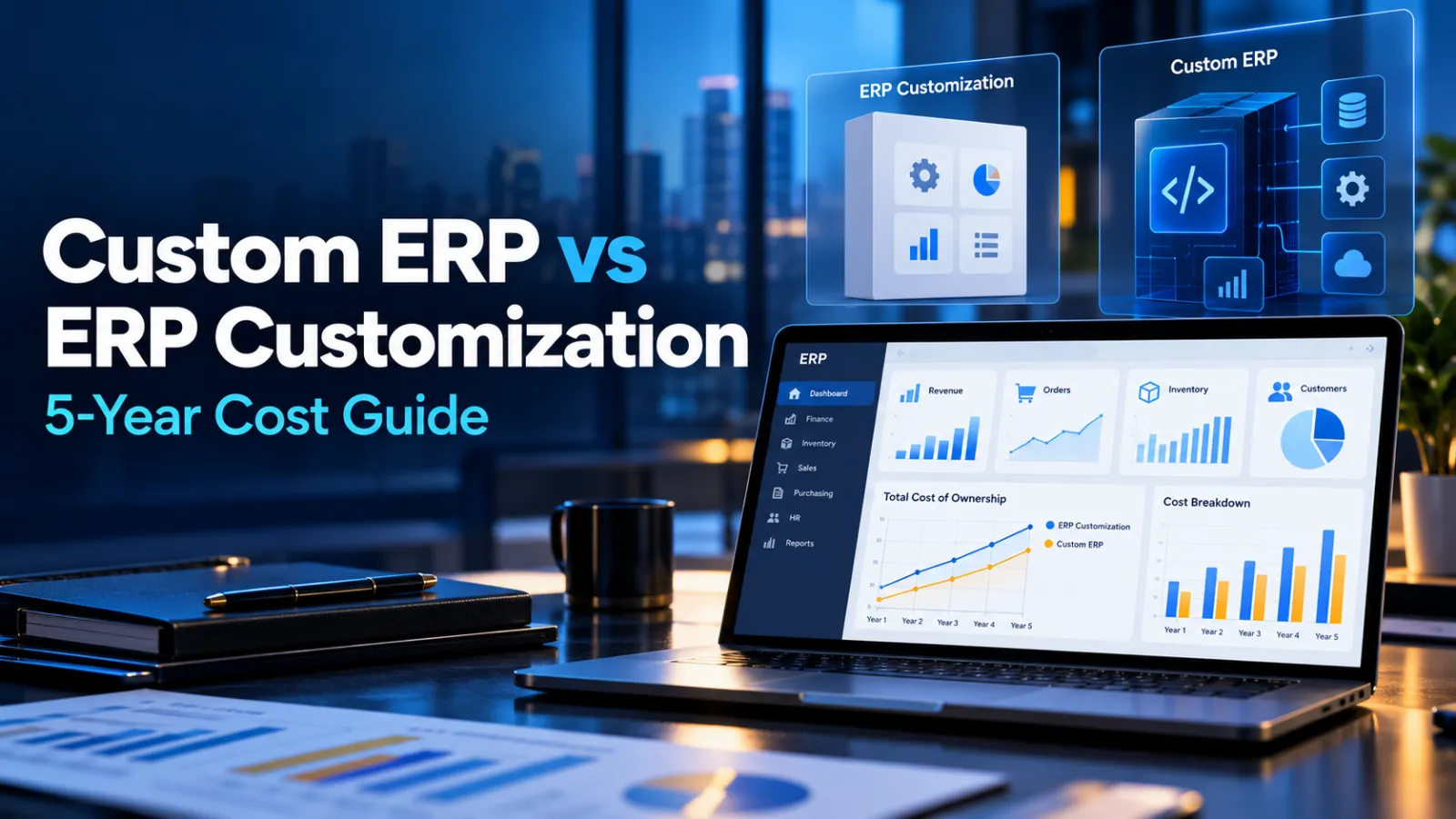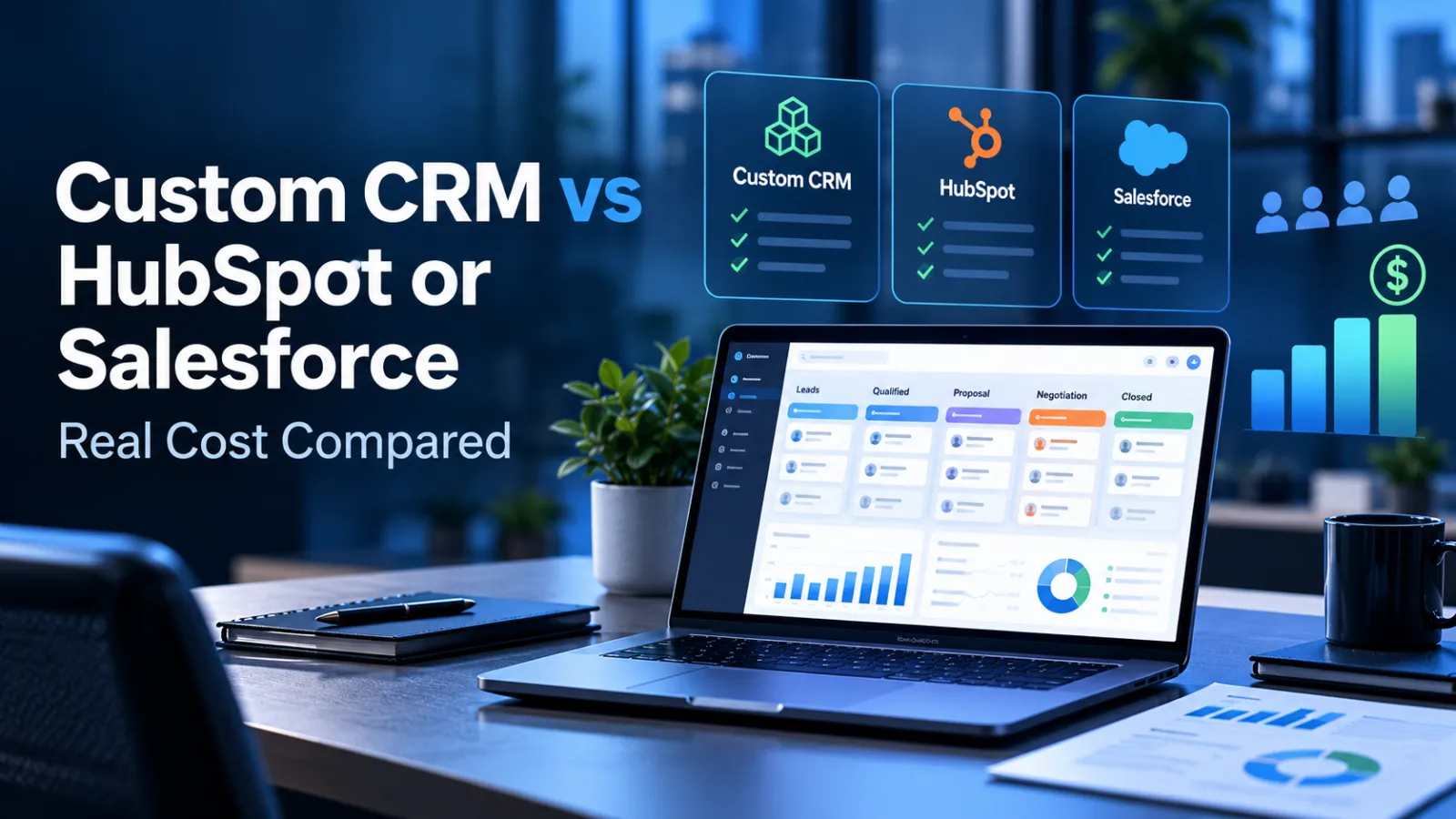
Custom ERP System: Costs, Modules, Process and Build-vs-Buy Guide
A practical guide to custom ERP modules, costs, implementation, risks and the decision between building and configuring an established platform.
DevGlim Team
September 5, 2026 · Updated September 30, 2026
Looking to build this instead of buying it? See our Custom ERP System Development service →

Photo by Egor Komarov via Pexels
Most growing businesses hit the same wall eventually: their operations have outgrown spreadsheets, but off-the-shelf enterprise resource planning platforms like SAP, NetSuite, or Odoo force them to reshape their entire workflow around software that wasn't built for them. A custom ERP system solves this by doing the opposite—the software is built around how your business actually operates, not the other way around.
This guide breaks down what a custom ERP system actually is, how custom ERP software development works, what it really costs, and how to decide if it's the right move for your business.
What Is a Custom ERP System?
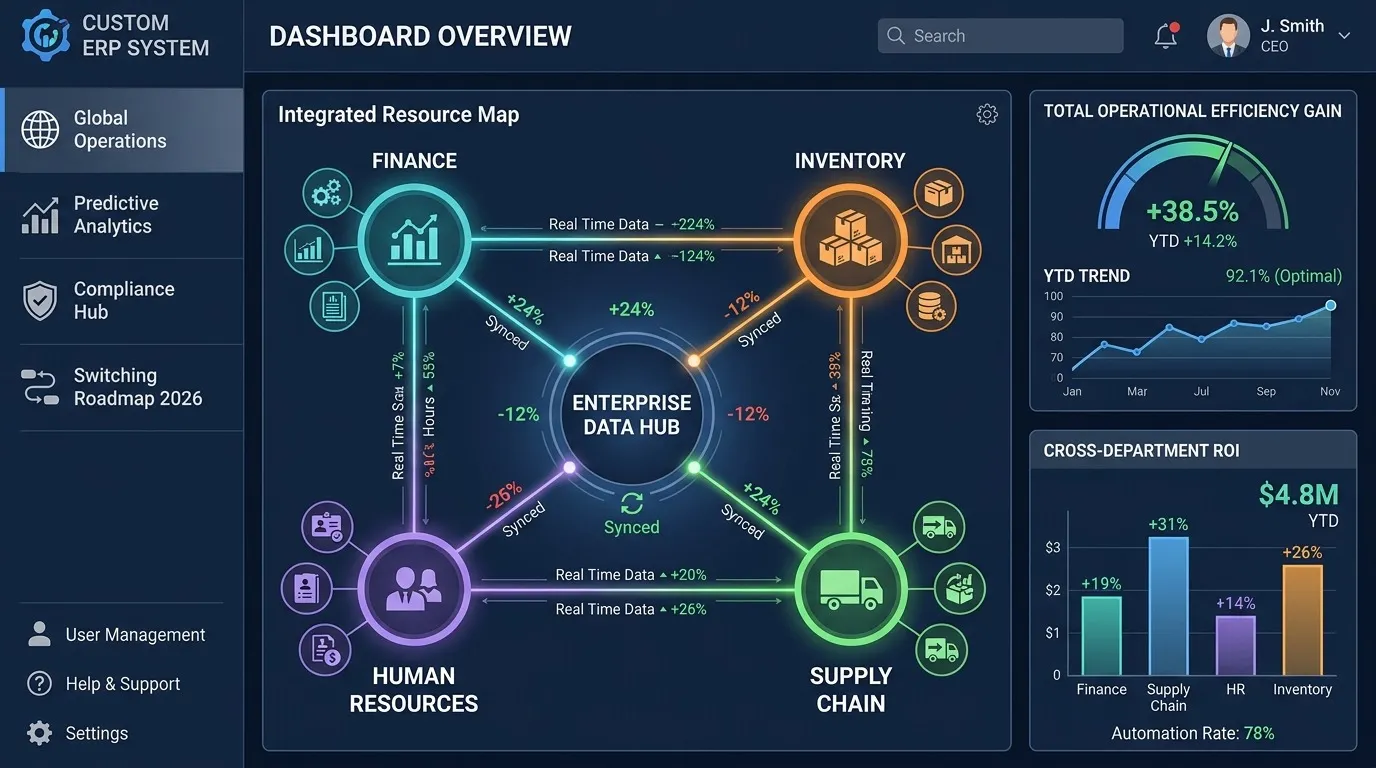
An enterprise resource planning (ERP) system centralizes core business functions—inventory, finance, HR, procurement, manufacturing, and reporting—into one connected platform instead of scattered, disconnected tools.
A custom ERP solution is one built specifically for your business's processes, rather than a generic platform you configure to approximately fit your needs. According to Gartner's research on enterprise software, organizations increasingly prioritize composable, adaptable systems over rigid, one-size-fits-all platforms. Similarly, Forbes Advisor's ERP overview notes that implementation flexibility is now a top evaluation factor for growing companies.

Photo by Thirdman via Pexels
Planning a custom ERP system? Use our free calculator to estimate the approximate project scope and complexity. Open the full-page tool.
Free tool · about 3 minutes
Custom ERP Cost Calculator
You will get:
- A complexity level and an estimated investment
- Suggested architecture and major components
- Off-the-shelf vs custom, explained for your answers
No sign-up needed to see your result. This is an indicative estimate based on the information provided. Final pricing depends on features, integrations, design complexity and project requirements.
Why Businesses Choose Custom ERP Development Over Off-the-Shelf
1. Your workflows aren't generic.
If your business has a non-standard production process, a unique compliance requirement, or a hybrid inventory model, forcing it into a general platform can require extensive configuration or customization. The right comparison includes implementation, licensing, integrations, migration, training and long-term maintenance—not software price alone.
2. Licensing costs compound over time.
Off-the-shelf ERP platforms charge per user, per month, indefinitely. Licensing can become a significant long-term cost as user counts and modules grow. Compare realistic three-to-five-year totals with the cost of building, hosting, supporting and securing a custom product.
3. You own the system outright.
A custom contract can provide code ownership and deployment control, but those rights are not automatic. Confirm source-code ownership, documentation, hosting access, maintenance responsibilities and exit support before signing.
4. It integrates natively with what you already use.
A custom enterprise system can connect directly to your existing CRM, accounting software, or industry-specific tools without third-party connector fees or brittle workarounds. Our CRM automation guide covers this integration layer in more depth if your ERP needs to sync with sales data.
What a Custom ERP System Typically Includes
- Inventory & warehouse management—real-time stock tracking across locations
- Finance & accounting — invoicing, expense tracking, financial reporting
- HR & payroll—employee records, attendance, payroll processing
- Procurement—purchase orders, vendor management
- Manufacturing/production tracking—job scheduling, materials usage
- Reporting & analytics dashboards—real-time visibility across departments
- Role-based access control—different permission levels per department

Photo by Tiger Lily via Pexels
The Custom ERP Development Process
Step 1: Discovery & Process Mapping (2-4 weeks)
Before any code is written, a proper development partner maps your actual operational workflows. This phase typically represents 15-20% of total project cost, and skipping it creates avoidable scope, migration and adoption risk.
Step 2: Architecture & Database Design (2-3 weeks)
The system's data structure gets designed around your specific entities—products, orders, employees, vendors—and how they relate to each other.
Step 3: Module Development (8-16+ weeks)
Modules are typically built and delivered incrementally so you can start using parts of the system before the full build is complete.
Step 4: Integration
The ERP gets connected to your existing tools, so data flows automatically instead of requiring manual re-entry.
Step 5: Testing & QA
Given how central an ERP becomes to daily operations, this phase deserves real time—typically 15-20% of total development time.
Step 6: Deployment & Training
Rollout is usually staged by department to avoid disrupting operations, with hands-on training for each team. For a broader view of scope, integrations and delivery options, see our custom ERP development service.
How Much Does a Custom ERP System Cost?
- Basic custom ERP (2-3 core modules, single location): $15,000–$40,000
- Mid-complexity ERP (5+ modules, multiple locations): $40,000–$120,000
- Enterprise-grade custom ERP (complex integrations, compliance needs): $120,000+
Beyond the initial build, budget separately for maintenance, infrastructure, support, upgrades and security work; the amount depends on the operating model and service level. Our custom software development guide breaks down these cost categories in more general detail.
Calculate ERP Total Cost of Ownership
Compare options over the same time horizon. Include discovery and configuration, development, data migration, integrations, licenses, cloud infrastructure, training, support, upgrades and the internal time required from process owners. Also estimate the operational cost of delays and manual work that remains after launch.
Use DevGlim's custom ERP cost calculator for a scope-based estimate, then validate the assumptions during discovery. It is a planning tool, not a binding quote.
Data Migration and Rollout Checklist
- Assign an owner to each dataset and agree on required history.
- Clean duplicate customers, vendors, products and chart-of-account mappings before import.
- Reconcile totals between source and destination systems with documented acceptance rules.
- Run role-based user acceptance tests using real end-to-end scenarios.
- Stage rollout by module, team or location and define a rollback plan.
- Track adoption, unresolved exceptions and manual workarounds after launch.
Signs Your Business Needs a Custom ERP Solution
- You're using 4+ disconnected tools that don't talk to each other
- Off-the-shelf ERP quotes keep requiring expensive "customization" add-ons
- Your team spends significant time manually re-entering data across systems
- You have industry-specific compliance requirements generic platforms don't handle well
- You're planning to scale and want a system that grows with you
Custom ERP vs. Popular Off-the-Shelf Options
If you're still weighing options, our SaaS vs. on-premise software comparison breaks down the deployment side of this decision, and Investopedia's ERP explainer is a useful neutral primer for stakeholders unfamiliar with the space.
Frequently Asked Questions
How long does custom ERP development take?
Most custom ERP builds take 4-9 months depending on the number of modules and integrations required.
Is custom ERP cheaper than SaaS ERP long-term?
Sometimes, but not automatically. The answer depends on users, modules, implementation effort, integrations, hosting, maintenance and how long the system will remain in use. Compare both options using the same three-to-five-year assumptions.
Can a custom ERP system integrate with QuickBooks, Shopify, or other tools we already use?
Yes, native integrations via API are one of the main advantages of custom ERP development.
What's the difference between ERP and CRM?
ERP manages internal operations like inventory, finance, and HR. CRM manages customer-facing relationships like leads and sales pipelines.
Do small businesses need a custom ERP, or is that only for large enterprises?
Not necessarily. A smaller business may justify custom development when it has a valuable, unusual workflow or integration need, but standard operations are often served more economically by a configured product.

Photo by Vitaly Gariev via Pexels
Final Thoughts
A custom ERP system isn't the right move for every business—if your operations are genuinely standard, an off-the-shelf platform configured properly can work fine. But if you're forcing your workflows into software that doesn't fit, a custom ERP can be justified when the measured value of workflow fit, integration and control exceeds its full lifecycle cost.
Ready to Build Your Own Custom ERP System?
DevGlim builds ERP systems designed around how your business actually operates. See our custom ERP development service or get in touch to talk through your specific requirements.