๐ŸŒŽ Now accepting projects from the USA, UK, Canada, Australia & Europe โ€” Booking Q4 2026 โ€” Request a Strategy Call

E-commerce development services

Custom Ecommerce Software Development Services

We design and build custom ecommerce platforms for businesses that have outgrown what Shopify, BigCommerce or WooCommerce can do: B2B pricing, ERP and inventory integration, headless storefronts and a checkout built around your rules.

Secure & reliable Custom solutions Ongoing support
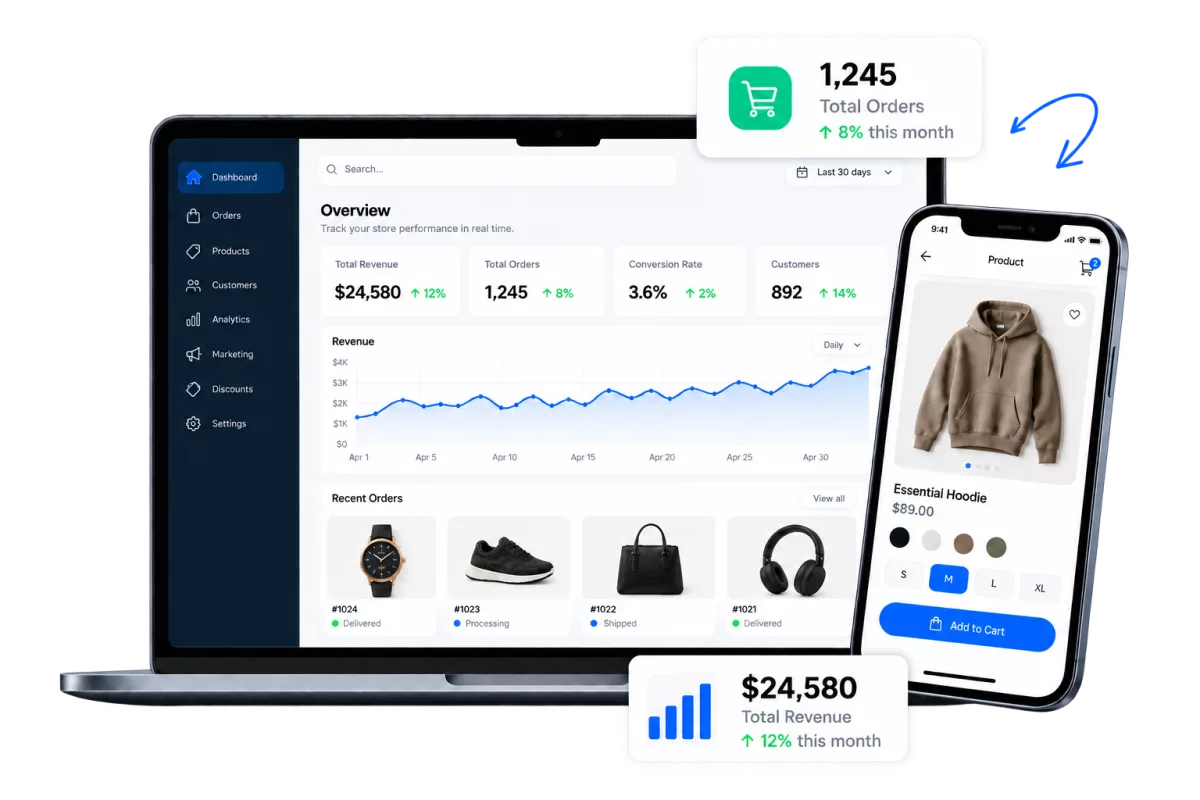
Ecommerce analytics dashboard displayed on a laptop and mobile storefront

Built around your business

Custom ecommerce development for businesses that have outgrown their platform

A hosted platform is the right starting point for many online stores. It stops being enough when the way you sell no longer fits its settings: prices that differ by customer, quotes and approvals before an order, stock that lives in an ERP or warehouse system, or a checkout that has to behave differently for different buyers. Teams in that position end up stacking plugins, exporting spreadsheets and re-keying orders by hand.

Custom ecommerce software development means building the parts of your store that set you apart, such as pricing logic, checkout, integrations and back-office tools, around your business instead of bending your business around a platform. Depending on the project, that can be a full custom build or a custom layer added to the platform you already use.

Not sure custom is the right move? We start with a free platform limitations review. We look at what your current platform can't do, where you're working around it, and what should stay as it is. Sometimes the honest answer is that your platform plus a few apps is enough.

Our e-commerce solutions

What we build

Headless and composable storefronts

In a headless setup, the storefront customers see is separate from the back end that manages products, orders and pricing, and the two communicate through APIs. That frees you from theme limits and lets one back end power several front ends, such as a website, a wholesale portal or an app. The trade-off is that you own more of the system, so it pays off when front-end freedom or performance control is worth the extra engineering.

B2B ecommerce: customer-specific pricing, quotes and approvals

B2B buyers don't pay list price. Custom B2B ecommerce handles customer-specific price lists, volume tiers, quote requests, purchase orders, account terms and approval flows, and shows each logged-in customer the prices and catalogue agreed with them. Where pricing lives in your ERP, the storefront can read it from there instead of keeping a second copy that drifts out of date.

ERP, inventory and back-office integration

A store that doesn't know your real stock oversells, and one that can't send orders to your ERP creates manual work. We connect the storefront to ERP, inventory, warehouse and accounting systems so stock, orders, customers and prices stay consistent. How much work that takes depends mostly on the other system's API and data quality, which we assess before we quote.

Custom checkout and payments

Checkout is where custom rules matter most: shipping and tax logic, split shipments, purchase-order or invoice payment, deposits, and different flows for retail and trade customers. Payments connect to the providers you choose through their APIs. Using hosted payment fields or a redirect from a PCI DSS-compliant provider can keep card data off your own servers, which reduces your compliance scope.

Admin tools and order management

Your team works in the back office every day. We build admin screens for catalogues, prices, orders, returns, customers and permissions, designed around your workflow so routine changes don't need a developer.

Why choose custom ecommerce

Built to scale

Scalability isn't one feature. For an ecommerce platform it comes down to decisions made early: how product and pricing data is structured, what can be cached and what must stay live (stock and price at checkout), how background jobs such as emails and inventory syncs are queued, how campaign traffic spikes are absorbed, and how each integration behaves when the system on the other end is slow or down. We work through these during architecture, before the build starts.

Performance
Flexible
Reliable
Global ready
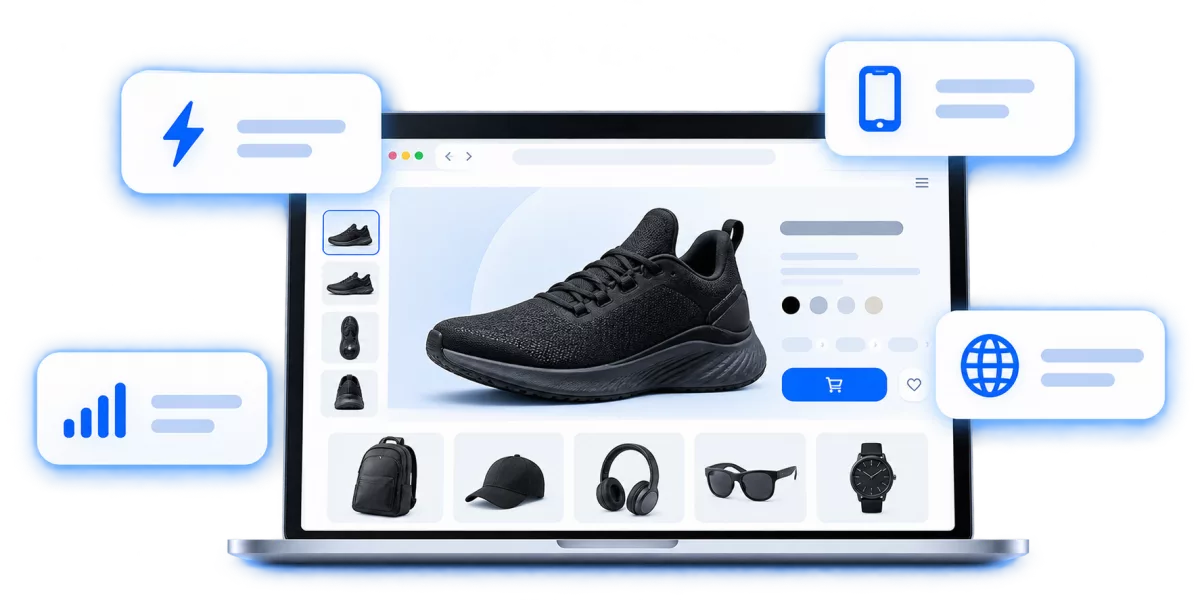
Scalable ecommerce storefront with performance and global commerce features

Platform options

Custom, platform or headless? How to choose

No option is right for everyone. This is how they usually compare.

Hosted platform (Shopify, BigCommerce, WooCommerce)

Full flexibility and control

  • Best when: Standard catalogue and checkout, mostly direct-to-consumer
  • Speed to launch: Fastest
  • Flexibility: Limited to platform features and apps
  • Ongoing costs: Subscription, app and transaction fees that grow with usage
  • Main risk: Hitting platform limits, app sprawl

Platform plus custom layer

Faster and cost-effective

  • Best when: The platform mostly works but a few rules don't fit
  • Speed to launch: Moderate
  • Flexibility: Good in targeted areas
  • Ongoing costs: Platform fees plus upkeep of the custom layer
  • Main risk: Depending on the platform's API and roadmap

Fully custom or headless

Maximum flexibility

  • Best when: Your pricing, checkout or integrations are central to how you compete
  • Speed to launch: Longest
  • Flexibility: Highest
  • Ongoing costs: Hosting, maintenance and development; a commerce back end may still carry fees
  • Main risk: More to build and maintain

Signs you may need custom ecommerce

Your pricing rules can't be modelled in the platform. Orders or stock reach your ERP by CSV or manual entry. A growing plugin stack slows the store or causes conflicts. Different customer groups need genuinely different buying flows. Platform fees and plugin costs are growing faster than the value they give you.

Our guide goes deeper on this decision: custom ecommerce software development guide.

Seamless integrations

Ecommerce integrations

A custom store is only as useful as the systems it connects to. These are the usual integration areas.

ERP and accounting: Orders, stock, prices and invoices.
Inventory, warehouse and POS: Accurate stock across every channel.
Payments: Cards, wallets and invoice terms.
Shipping and fulfilment: Rates, labels and tracking.
Tax: Calculation and reporting.
CRM and marketing: Customer data and email triggers.
Product information and content: PIM and CMS.
Marketplaces and other sales channels: Listings, orders and stock kept in sync.
Analytics and reporting: Sales, stock and customer reporting.

Not sure whether your system has an API we can use? The platform review covers that.

Your ecommerce platform
ERP and accounting
Inventory, warehouse and POS
Payments
Shipping and fulfilment
Tax
CRM and marketing
Product information and content
Marketplaces and other sales channels

Our process

How a custom ecommerce project runs

01

Platform and requirements review

What works, what doesn't, and what to keep.

02

Architecture and integration mapping

We choose the architecture and document every system connection and data flow.

03

Data and migration plan

Products, customers and order history, plus redirects for existing URLs so you don't lose search rankings.

04

Phased build and testing

Features are released in stages, with checkout, payment and integration testing.

05

Launch and support

Cutover, monitoring and post-launch support.

What custom ecommerce development costs

Devglim e-commerce projects start from $900, and a normally scoped, complete store typically falls in the range of $900โ€“$2,500. Marketplaces, multi-vendor platforms, B2B builds with ERP sync and migrations, and other highly custom commerce systems can exceed that and are quoted based on scope. These are the factors that move the price most.

Scope and buyer types: B2C, B2B or both, and how many admin roles you need.
Integrations: The number of systems, and the quality of each one's API.
Catalogue and pricing complexity: Variants, bundles, customer-specific price lists and promotion rules.
Data migration: Products, customers and order history from your current platform.
Storefront design: A custom headless front end takes more design and build effort than a themed one.
Performance, security and compliance: Traffic peaks, uptime targets and payment security requirements.
Hosting and support: What you need after launch.

Beyond the build, plan for hosting, maintenance and improvements, and compare that with what a platform would cost you in subscriptions, apps and fees over the same period. After the platform review we can split the project into modules and phases, so you see the cost of each part.

See also our pricing page.

How long a custom ecommerce build takes

Timelines depend on the same factors as cost, plus how quickly your team can decide, provide content and give access to other systems. A store with a standard checkout and one integration is a very different project from a B2B platform with ERP sync and migration. Phasing helps: launching the highest-value parts first delivers value sooner than waiting for everything.

Security, reliability and compliance

Payment and customer data need care from the start. Good practice means keeping card data with PCI DSS-compliant payment providers where possible, controlling who can do what in the admin, logging changes to prices and orders, keeping dependencies patched, and running backups and monitoring. We design with these in mind.

Frequently asked questions

What is custom ecommerce software development?

Building an online store, or key parts of one, around your business rules instead of adapting to a platform's built-in features. It can be a full build, a headless storefront on a commerce back end, or a custom layer on your existing platform.

When should we choose custom ecommerce instead of Shopify or BigCommerce?

When your business rules no longer fit a platform: customer-specific B2B pricing, quotes and approvals, stock held in an ERP, or checkout logic a platform can't support. If a platform plus a few apps covers your needs, it is usually faster and cheaper.

How much does custom ecommerce development cost?

Devglim e-commerce projects start from $900, and a normally scoped, complete store typically falls in the range of $900โ€“$2,500. Highly custom platforms are quoted based on scope. The biggest factors are integrations, pricing and catalogue complexity, migration, storefront design and security requirements. Contact us with your requirements and we will scope it.

How long does a custom ecommerce build take?

It varies with scope and integrations. Phasing lets the most valuable parts launch first.

What is headless ecommerce, and do we need it?

The storefront and the commerce back end are separate and talk through APIs. It suits teams that want full control of the front end, or several front ends on one back end, and it means owning more of the system.

Can you integrate a custom store with our ERP, inventory or accounting system?

Usually, yes. The effort depends on the other system's API and data quality, which we review during scoping. The goal is that stock, orders, customers and prices stay in sync in both directions.

Can we keep our current platform and build only what it can't do?

Often. A custom layer for B2B pricing or checkout can sit on top of an existing platform. We assess this in the platform review before recommending a rebuild.

How do you handle data migration from our current store?

We plan it before the build: products, customers and order history, plus URL redirects so existing search rankings are protected.

Will a custom platform handle traffic spikes?

That depends on architecture: caching, queued background work, and how integrations behave under load. These are planned at the architecture stage, and we don't promise traffic numbers without testing.

How is payment security handled?

The usual approach is to keep card data with PCI DSS-compliant payment providers using hosted fields or redirects, which reduces your compliance scope.

How do we choose a custom ecommerce development company?

Ask for relevant case studies, evidence of integration experience with systems like yours, who owns the code, how phases and costs are quoted, and what support follows launch.

Pricing

E-commerce projects from $900

Typical investment: $900โ€“$2,500

Final pricing depends on features, integrations, design complexity and project requirements. Complex projects are quoted based on scope.

Not sure whether custom is right for you?

Start with a free platform limitations review. Tell us what your current platform can't do and we'll tell you honestly whether custom, a platform plus a custom layer, or staying put makes sense.

WhatsApp

DevGlim AI

GPT-4o

Online ยท Always ready

WhatsApp

WhatsApp Support

Need immediate assistance? Chat directly with our human engineering team.

Open WhatsApp

Back to Top

Instantly jump back to the top of the page.