What Is a Digital Twin in Manufacturing? A Plain-English Guide
Cutting through the hype: what a manufacturing digital twin actually is, how it's built, and the difference between a real one and a marketing slide.
DevGlim Team
September 17, 2026
Looking to build this instead of buying it? See our Industry Management Systems service →
"Digital twin" gets used two ways in manufacturing conversations: as a genuinely useful engineering tool, and as a buzzword slapped on a 3D model that doesn't actually connect to anything. This guide covers the real version — what a digital twin actually is, how it's built, and when it's worth the investment.
What a Digital Twin Actually Is
A digital twin is a live, data-fed virtual model of a physical asset — a machine, a production line, or an entire plant — that updates continuously from real sensor data rather than being a static 3D render. The defining feature isn't the visualization; it's the connection. If the model doesn't update when the physical equipment's state changes, it isn't a digital twin, it's a CAD file.
That live connection is what makes a digital twin useful: you can simulate a change (a new production schedule, a different maintenance interval) against the model before touching the real equipment, and the model's predictions stay grounded in what's actually happening on the floor.
How It's Built: Sensors, Pipeline, Model, Dashboard
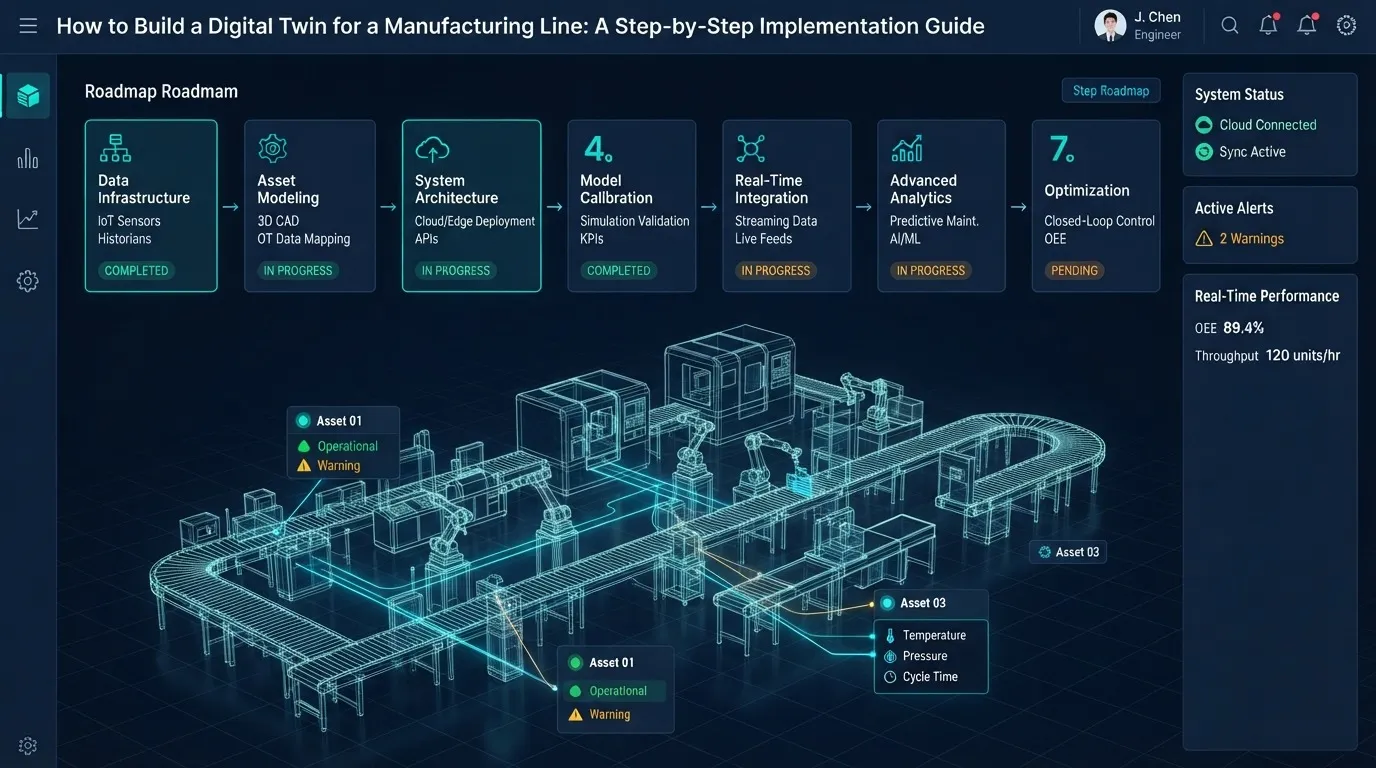
Every working digital twin has the same four layers, regardless of industry:
- Instrumentation. Sensors on the physical asset — vibration, temperature, throughput, cycle time — feeding data out via IoT gateways or existing PLC/SCADA connections.
- Data pipeline. A path from those sensors into a system that can store and process the data in near-real time, usually a time-series database plus a message broker (MQTT, Kafka) to handle the stream.
- The model. A simulation or predictive model — physics-based, statistical, or a trained ML model — that consumes the live data and represents the asset's current and projected state.
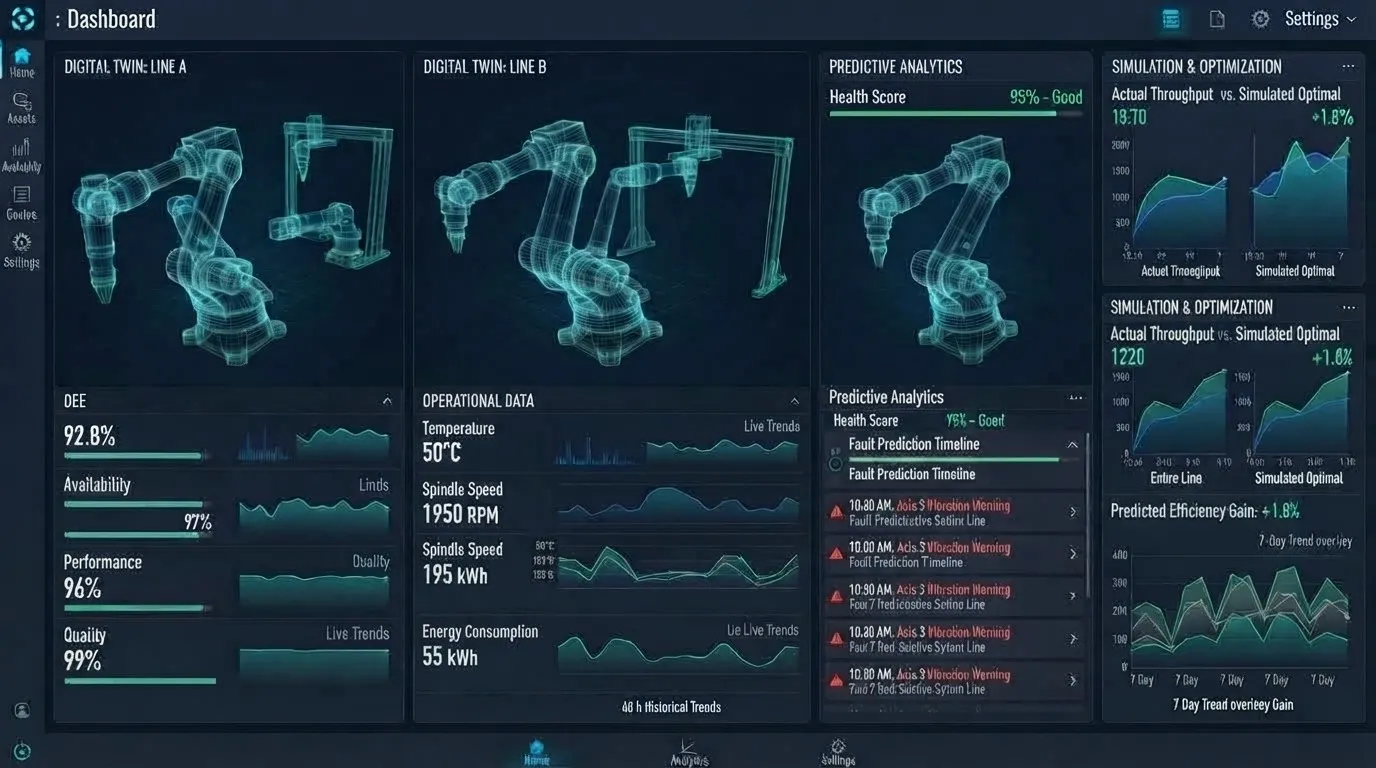
- Interface. A dashboard or application layer where engineers and plant managers actually interact with the twin: viewing current state, running what-if scenarios, receiving alerts.
Most failed digital twin projects fail at the second layer, not the fourth — companies buy a slick dashboard before they've solved the harder problem of getting clean, reliable, real-time data out of decades-old equipment.
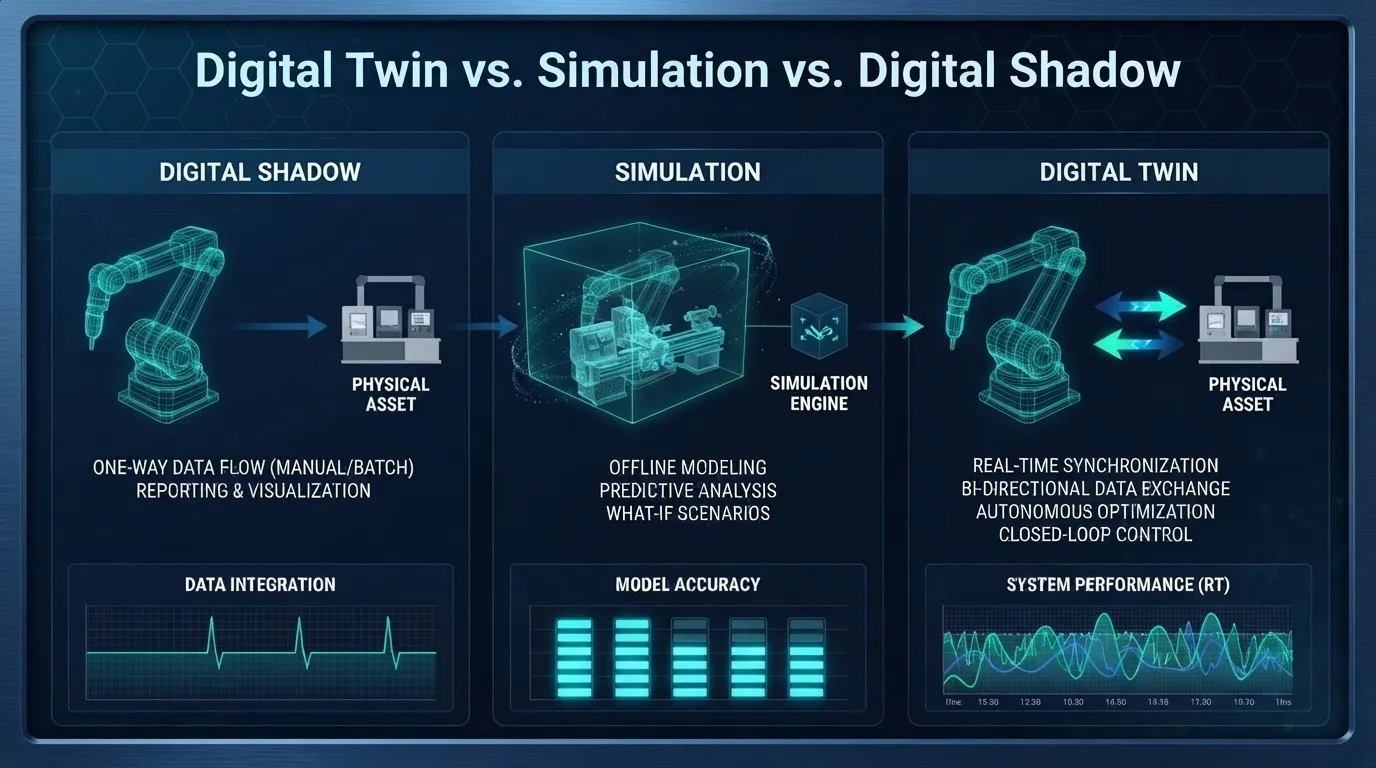
Digital Twin vs. Simulation vs. Digital Shadow
These three terms get used interchangeably and shouldn't be — see digital twin vs. simulation vs. digital shadow for the full breakdown. Briefly: a simulation runs on hypothetical or historical data — useful for planning, but not connected to the live asset. A digital shadow is one step further: it receives live data from the physical asset, but the flow is one-directional, so changes to the model don't feed back into the physical system. A true digital twin closes the loop — data flows both ways, so a change simulated in the model can be pushed back to adjust the physical process.
Most manufacturers deploying "digital twins" today are actually running digital shadows, and that's fine — a one-directional feed is a reasonable, lower-cost starting point before investing in full bidirectional control.
What It Actually Does on the Shop Floor
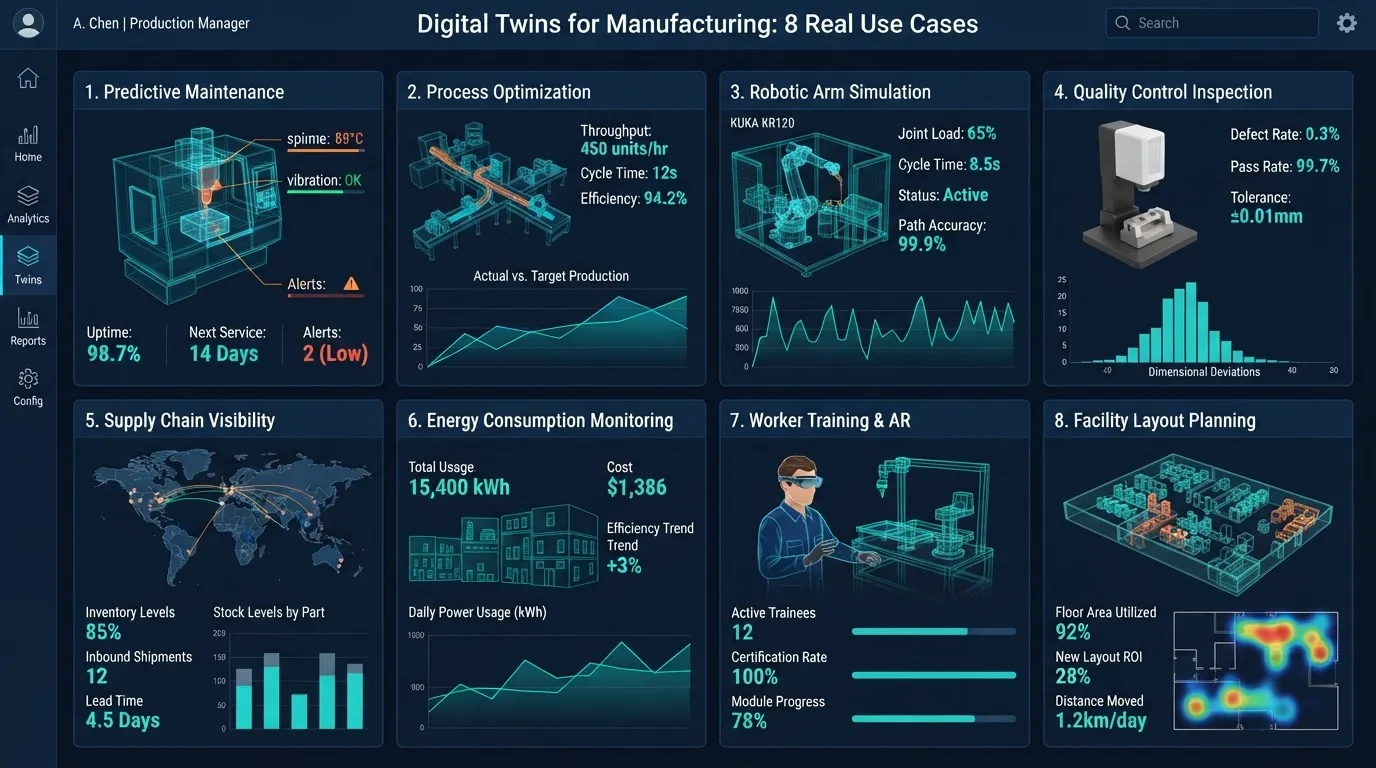
Three use cases account for most real deployments:
- Predictive maintenance. The model learns normal vibration/temperature/current signatures for a piece of equipment and flags deviations before they become failures, instead of waiting for a fixed maintenance interval or a breakdown.
- Line simulation. Before committing to a schedule or layout change, planners run it against the twin to see the effect on throughput and bottlenecks, catching problems that wouldn't be obvious from a spreadsheet.
- Quality and process drift. The twin flags when a process is trending out of the parameters that produced good output historically, catching quality issues before they show up in finished-goods inspection.
Is It Worth It for Your Plant?
A digital twin is worth building when a piece of equipment or line is expensive enough to fail, complex enough to be hard to reason about by intuition alone, and already instrumented enough that the data pipeline isn't the whole project. If your production line is running on 15-year-old PLCs with no data output at all, that instrumentation gap is the real first project — a twin is the second phase, not the first.
The next article in this series covers eight real digital twin use cases in more depth, and how to actually build one if you're past the "should we" question and on to "how." If you're weighing whether your plant is instrumented enough to start, talk to our engineering team — that's usually the first thing worth checking before scoping a project.