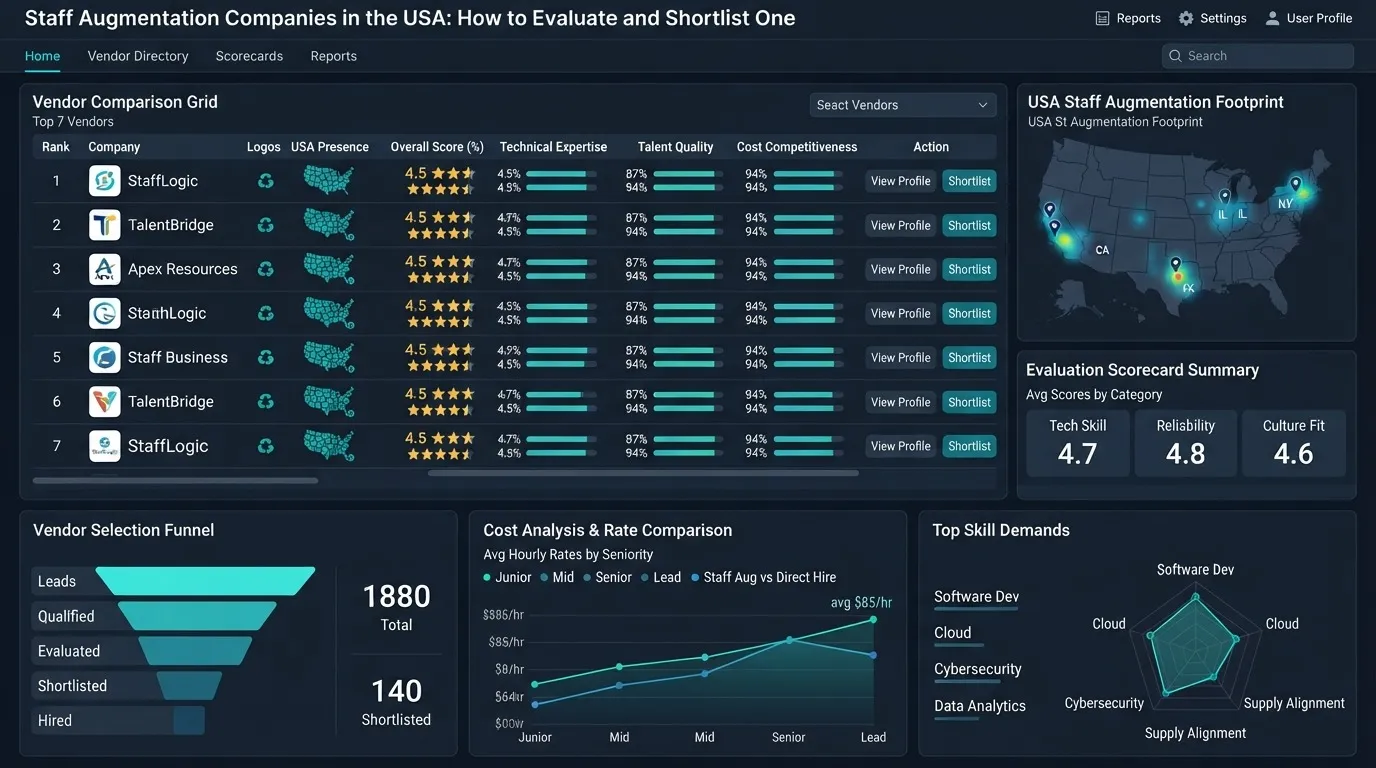
Staff Augmentation Companies in the USA: How to Evaluate and Shortlist One
A shortlist checklist for evaluating staff augmentation providers serving US teams — what actually matters versus what sounds good in a sales call.
DevGlim Team
September 17, 2026
Looking to build this instead of buying it? See our Custom Software Development Services service →
Searching for a staff augmentation company usually starts after a hiring plan has stalled or a project needs capacity faster than a full-time search can deliver — see the full staff augmentation guide if you're still confirming this is the right model first. The market is crowded with providers that all sound similar on a sales call — here's what actually separates a good one from a risky one.
Ask to See the Actual Person, Not a Profile
The single biggest predictor of a bad engagement is a provider that sells you on their company's capabilities in general terms and only introduces the actual developer after the contract is signed. A serious provider will let you interview the specific person (or short list of candidates) who would be placed, review their real prior work, and assess fit before you commit — the same diligence you'd apply to a direct hire.
Check Timezone and Communication Overlap
For US-based teams working with providers overseas, verify real-time overlap hours upfront, not just "they're flexible." A few hours of daily overlap for standups and pairing matters more than total headcount available — an augmented developer who's asleep during your entire working day adds latency to every decision, regardless of skill.
Verify Employment Structure and Continuity
Ask directly whether the developer is a full-time employee of the staffing company or a subcontracted freelancer brought on for your project specifically. Employees tend to have more continuity (less risk of the person leaving mid-engagement) and are usually better vetted, since the staffing company has an ongoing relationship and reputation riding on their performance across multiple clients.
Understand the Replacement and Ramp-Down Terms
Ask what happens if the placed developer isn't a good fit after a few weeks — is there a replacement guarantee, and how fast? Equally, check the notice period for scaling down: month-to-month with a short notice period is the point of augmentation's flexibility; a long lock-in defeats the purpose.
Look for Domain-Specific Experience, Not Just Tech-Stack Match
A developer who knows React is a start; a developer who's worked in your specific domain (fintech compliance, healthcare data, manufacturing systems) ramps up faster and asks better questions early. For specialized roles — the UX/UI-specific or industry-vertical augmentation needs — this matters more than general seniority.
Red Flags Worth Walking Away From
- Vague answers about who specifically would be placed, or reluctance to let you interview candidates directly.
- Pricing that seems significantly below market rate for the stated seniority level — usually means the seniority claim doesn't hold up.
- No clear escalation path if the engagement isn't working, or contract terms that make it costly to exit early.
- An inability to explain their vetting process for candidates beyond "we test their skills."
A good staff augmentation relationship should feel, within a few weeks, indistinguishable from having hired well internally — same accountability, same visibility into their work, just without the multi-month hiring cycle.