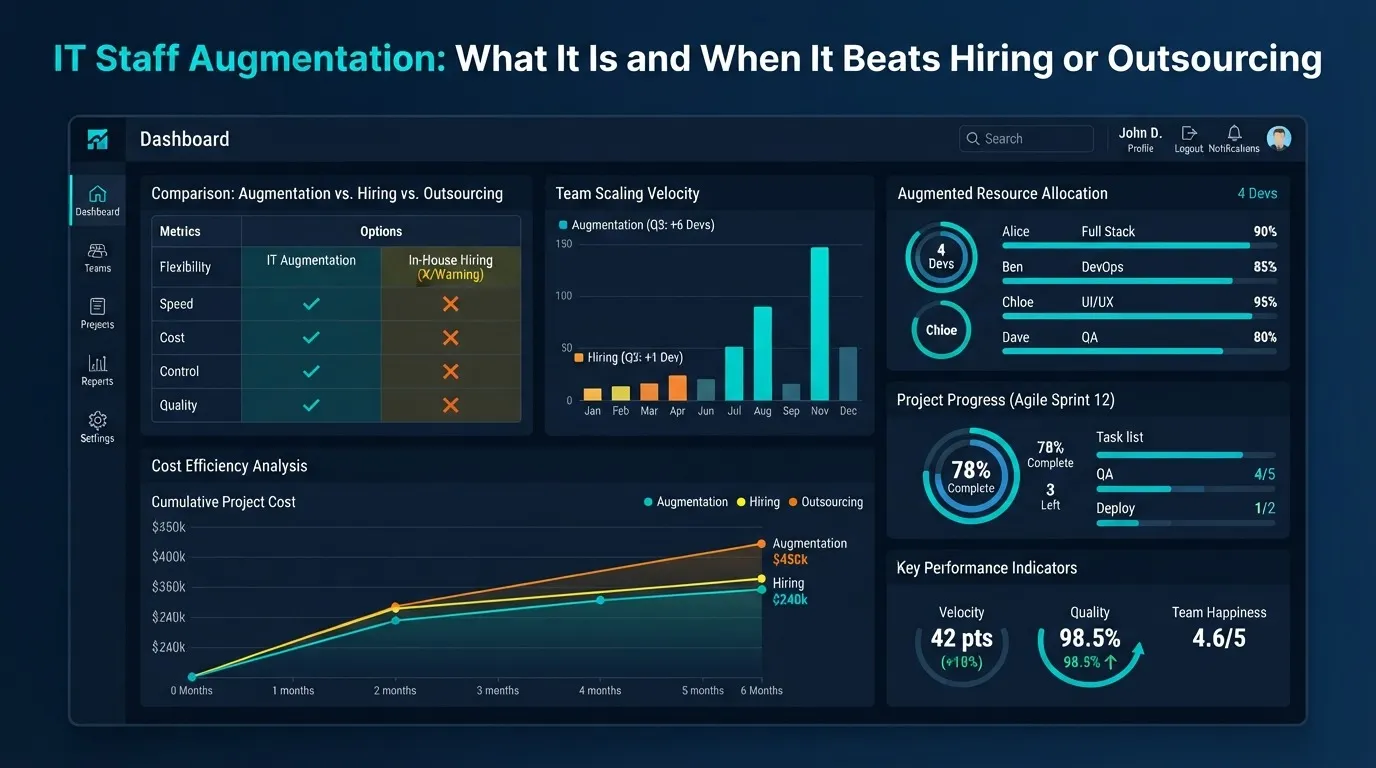
IT Staff Augmentation: What It Is and When It Beats Hiring or Outsourcing
A practical breakdown of what staff augmentation is, how the pricing and contracts actually work, and when it beats hiring or full project outsourcing.
DevGlim Team
September 17, 2026
Looking to build this instead of buying it? See our Custom Software Development Services service →
When a team is short on capacity or a specific skill, there are three real options: hire full-time, outsource the whole project, or bring in augmented staff who work inside your existing team. Staff augmentation is the least-understood of the three, and often the right one — here's what it actually involves.
What Staff Augmentation Actually Is
Staff augmentation places an individual contractor or a small group of contractors directly inside your existing team, under your management and processes, rather than handing off a chunk of work to an external team running its own process. The augmented developer joins your standups, uses your tools, and reports to your lead — the difference from a full-time hire is contractual and administrative, not operational.
This is distinct from project-based outsourcing, where an external vendor owns the delivery, manages its own team, and hands you a finished result against a scope and timeline they're responsible for.
Staff Augmentation vs. Outsourcing vs. Hiring
- Hiring gives you full control and long-term continuity but is slow (weeks to months to fill a role) and carries fixed overhead regardless of workload.
- Outsourcing is fastest to hand off a defined scope but gives you the least day-to-day control over how the work gets done, and works best when the scope is well-defined upfront.
- Staff augmentation sits in between: faster than hiring (typically 1-3 weeks to place someone vs. months to hire), keeps the work inside your process and management, and scales up or down without the fixed cost of full-time headcount.
When It's the Right Call
Staff augmentation makes the most sense when: you have a defined, ongoing need for a skill you don't want to build in-house yet (a specific framework, DevOps expertise); you're scaling a team up temporarily for a crunch period (a launch, a migration) without wanting to hire and then lay off; or you need to fill a role fast while a full-time hiring process runs in parallel.
It's the wrong tool when the work is a self-contained project with a clear deliverable and you don't have the internal management bandwidth to direct another person — that's a better fit for outsourcing.
How Pricing and Contracts Typically Work
Staff augmentation is usually billed hourly or as a monthly rate per placed developer, scoped to a role and seniority level rather than a fixed project price. Contracts are typically month-to-month or with a short notice period, which is the actual source of the flexibility — you're not locked into a year-long commitment to keep someone on if priorities shift.
Watch for two hidden costs: onboarding time (an augmented developer still needs ramp-up on your codebase and context, same as a new hire) and management overhead (someone on your team still needs to direct the work — augmentation adds capacity, not management capacity).
What Good Staff Augmentation Actually Looks Like
The augmented developer should be indistinguishable from a strong hire in daily work: proactive communication, ownership of their piece of the codebase, and genuine familiarity with the technology, not just resume keywords. If a staffing partner can't tell you specifically who they'd place and show relevant prior work, that's a signal to look elsewhere before signing anything.
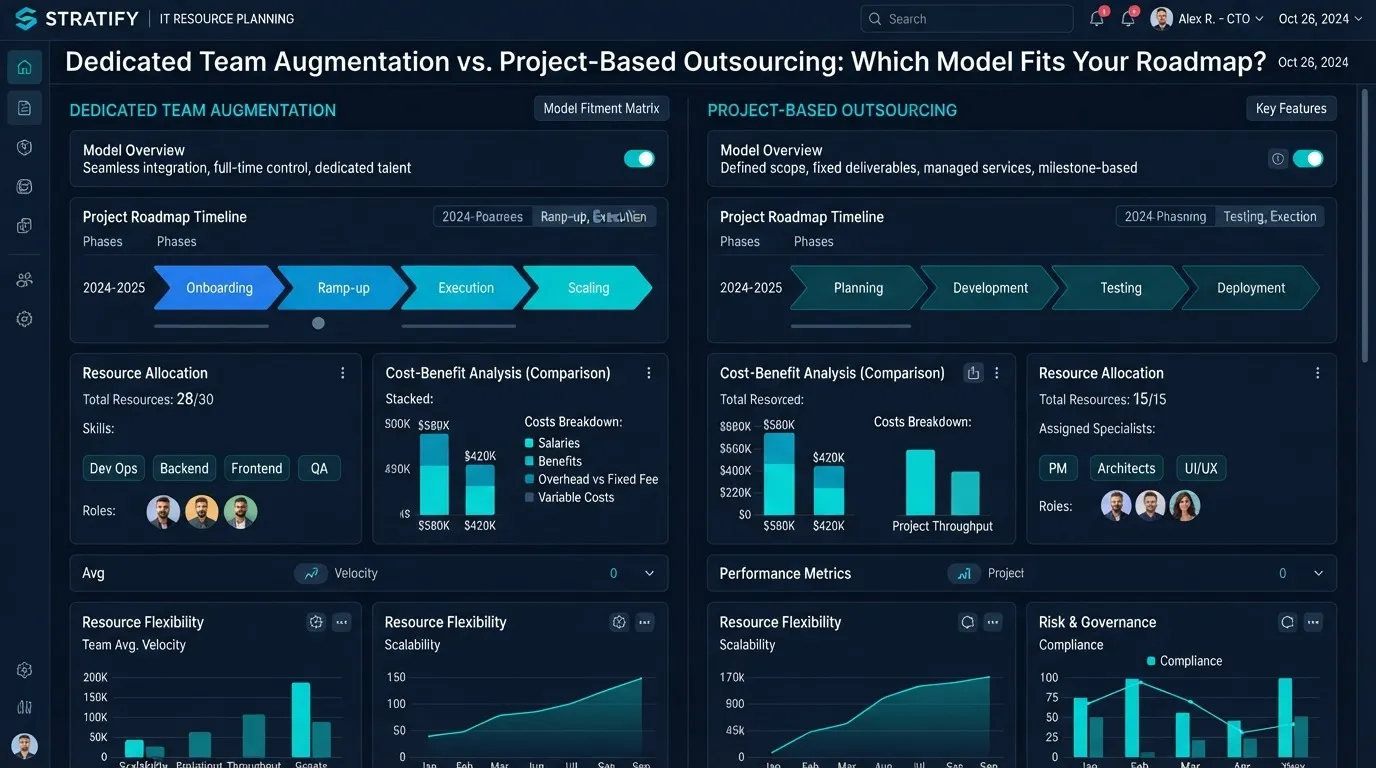
For a closer look at how to actually vet a staffing partner, see how to evaluate staff augmentation companies. If you're still deciding whether augmentation is even the right model, dedicated team augmentation vs. project-based outsourcing lays out the decision framework, and UX/UI-specific augmentation covers the design-hiring case in more depth. If you'd rather just talk through your specific gap, get in touch and we'll tell you honestly whether augmentation, outsourcing, or a hire is the right fit.