Dedicated Team Augmentation vs. Project-Based Outsourcing: Which Model Fits Your Roadmap?
These two engagement models get pitched as interchangeable by vendors selling both. They solve different problems — here's how to tell which one you actually need.
DevGlim Team
September 17, 2026
Looking to build this instead of buying it? See our Custom Software Development Services service →
Vendors that offer both dedicated team augmentation and project-based outsourcing will often let you choose based on budget rather than fit — but the two models solve genuinely different problems, and picking the wrong one shows up as friction three months in, not on day one. (New to the concept first? Start with what staff augmentation actually is.)
The Core Difference: Who Owns the "How"
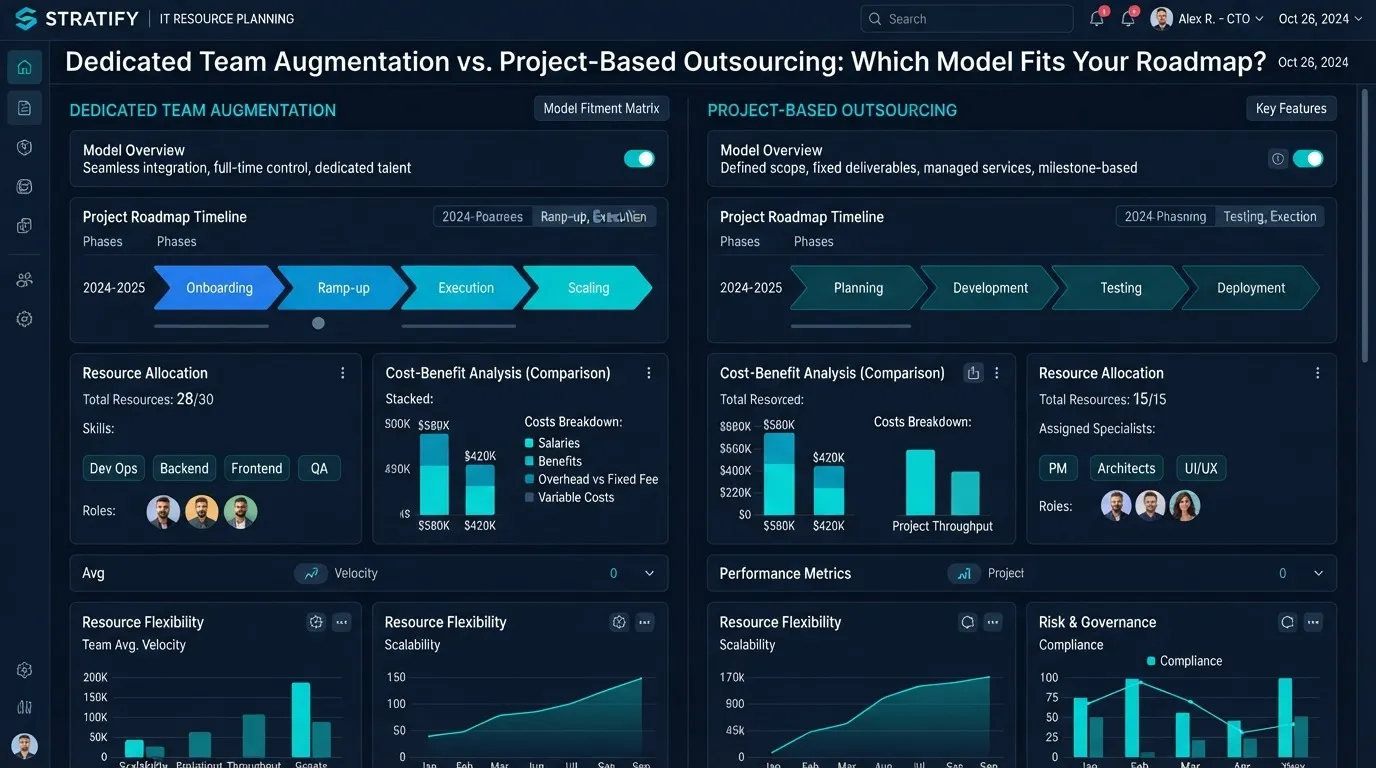
In project-based outsourcing, you hand over a scope and a deadline, and the vendor's team decides how to deliver it — their process, their architecture decisions, their internal management. You're buying an outcome.
In dedicated team augmentation, the people you bring on work inside your process, under your technical leadership, contributing to a roadmap that's still actively being defined and adjusted by your team. You're buying capacity, not an outcome.
When Your Roadmap Is Fixed: Outsourcing Fits Better
If you can write a clear specification today — a defined feature set, a fixed deadline, acceptance criteria that won't change mid-project — outsourcing lets a vendor own execution risk against that spec. This works well for a self-contained project: a new marketing site, a well-scoped integration, a defined MVP with locked requirements.
When Your Roadmap Is Still Evolving: Augmentation Fits Better
If the work is ongoing product development where priorities shift sprint to sprint based on user feedback, market changes, or dependencies on other in-flight work, augmentation keeps the added capacity inside the same decision-making loop as your core team — no re-scoping a contract every time priorities change.
The Management Cost Trade-off
Augmentation requires your team to actively manage the added people — technical direction, code review, sprint planning capacity. If your internal leads are already stretched thin, adding augmented headcount without adding management bandwidth just moves the bottleneck rather than solving it. Outsourcing, by contrast, delegates that management to the vendor — at the cost of losing direct control over day-to-day decisions.
A Simple Decision Framework
- Fixed scope, fixed deadline, self-contained: outsource it.
- Ongoing product work, evolving priorities, needs to stay inside your process: augment your team.
- Short-term spike in a specific skill you don't have in-house: augment, since you need it integrated with existing architecture decisions, not delivered as a separate module.
- You don't have spare management capacity to direct more people: lean toward outsourcing, or a hybrid where a vendor provides both the augmented developers and a lead to manage them.
Many engagements end up hybrid in practice — a fixed-scope outsourced project for a new initiative, with augmentation covering an ongoing capacity gap on the core product team. The mistake is picking one model for both situations because it's what the vendor happens to sell. Once you've settled on augmentation, here's how to evaluate a provider before signing anything.