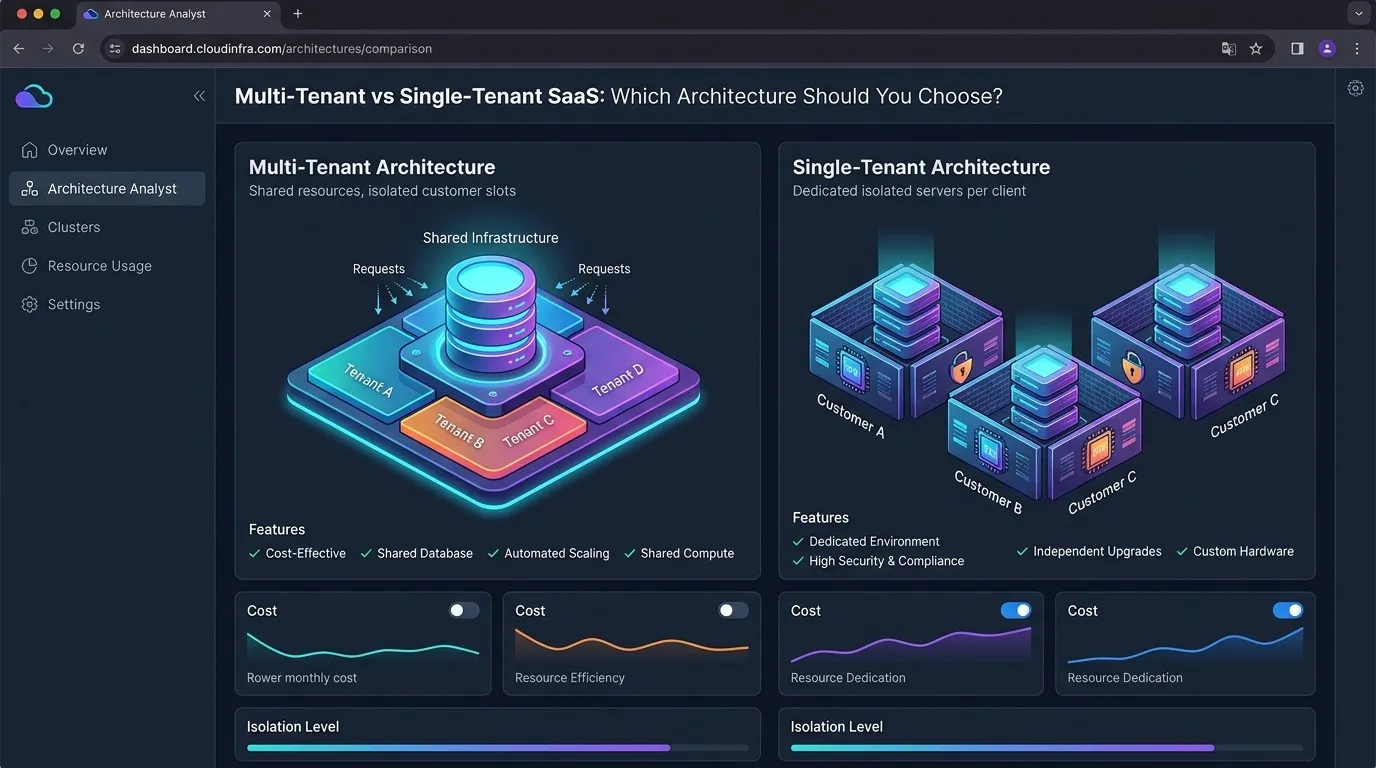
Multi-Tenant vs Single-Tenant SaaS: Which Architecture Should You Choose?
Shared infrastructure keeps SaaS affordable; isolation wins enterprise deals. Here is how to weigh the trade-offs for your product.
DevGlim Team
October 26, 2026
Looking to build this instead of buying it? See our SaaS Development service →
One of the first architectural decisions in a SaaS product is how customers (tenants) share infrastructure. It affects hosting cost, security reviews, how you deploy updates and which customers you can sell to. There is no universally right answer, but there is usually a right answer for your stage and market.
Definitions
Multi-tenant: customers share the same application and usually the same database, with every record tagged to its tenant. Single-tenant: each customer gets their own application instance and database, sometimes their own infrastructure.
Between the two sit common hybrids: a shared application with a separate database or schema per tenant, or a shared platform with dedicated instances for a few large customers.
Comparison
Multi-tenantSingle-tenant Hosting cost per customerLowHigher Deploying updatesOnce for everyonePer instance; needs automation Data isolationLogical, enforced in codePhysical Per-customer customizationLimited, via settingsEasier, but adds maintenance Enterprise security reviewsMore questions to answerOften easier Noisy-neighbour riskPresent; needs limitsMinimal When multi-tenant fits
Most SaaS products start multi-tenant: many small and mid-sized customers, standard features and a need to keep costs low. The key requirement is rigorous tenant scoping in every query, with automated tests that prove one tenant cannot read another's data.
When single-tenant or hybrid fits
- Customers in regulated industries require dedicated databases or specific hosting regions.
- A few large customers have very different load or custom requirements.
- Contracts require customer-controlled update schedules or encryption keys.
A common path is to build multi-tenant, but design so a tenant's data can be moved to a dedicated database later. That keeps early costs low while leaving the enterprise door open.
Operational points either way
- Automate provisioning, migrations and backups per tenant.
- Monitor usage per tenant to spot heavy users.
- Plan how a customer exports or deletes their data.
For the fundamentals, read how SaaS works and our guide to SaaS MVP costs. DevGlim's SaaS team can help you choose a tenancy model that fits your market.