
Real Estate CRM Development Cost: What Changes the Budget?
A practical framework for estimating a custom real estate CRM without relying on misleading one-price-fits-all figures.
DevGlim Team
September 22, 2026 · Updated September 22, 2026
Looking to build this instead of buying it? See our A Custom Real Estate CRM Built Around Your Exact Workflow service →
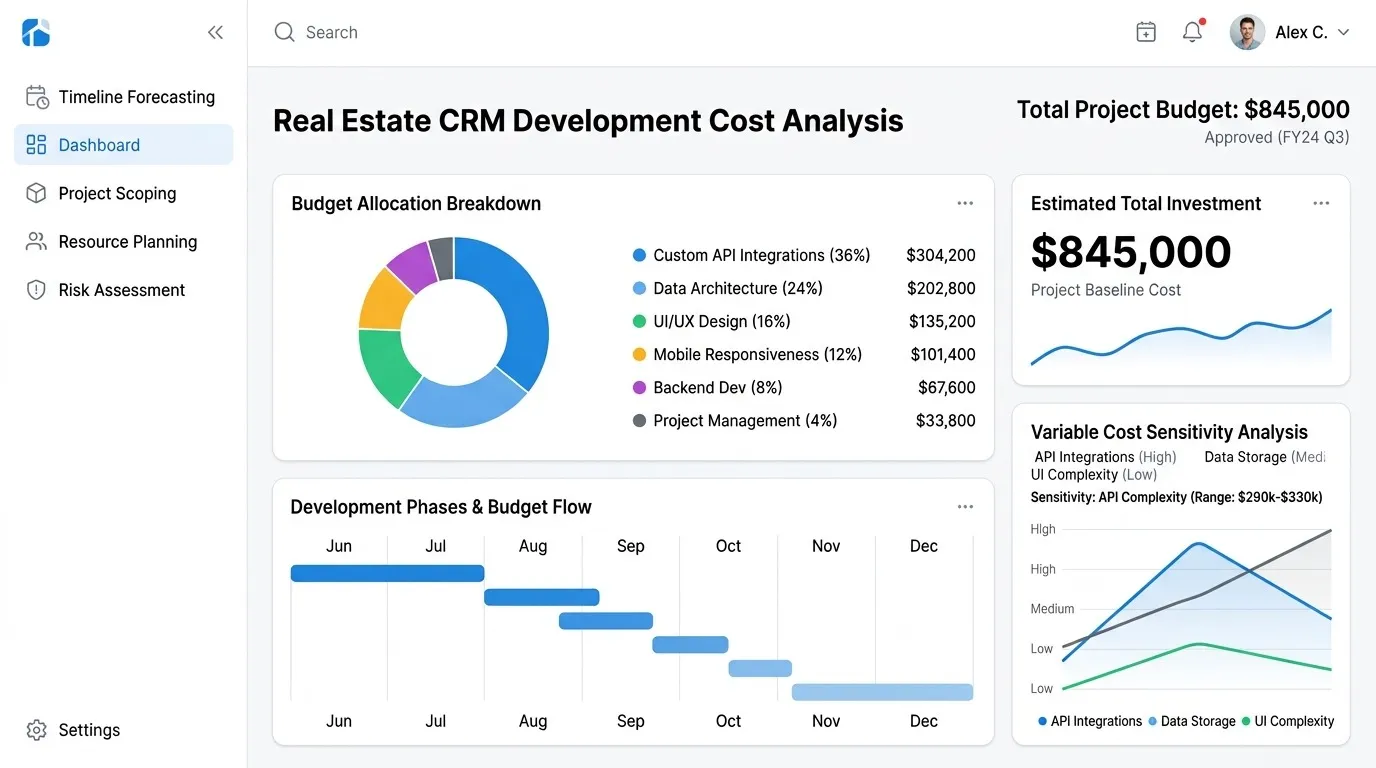
Real estate CRM development cost is determined less by the word “CRM” and more by the operating system the business actually needs. A contact list with tasks is a different product from a platform that connects sellers, buyers, properties, offers, documents, communications, permissions and reporting.
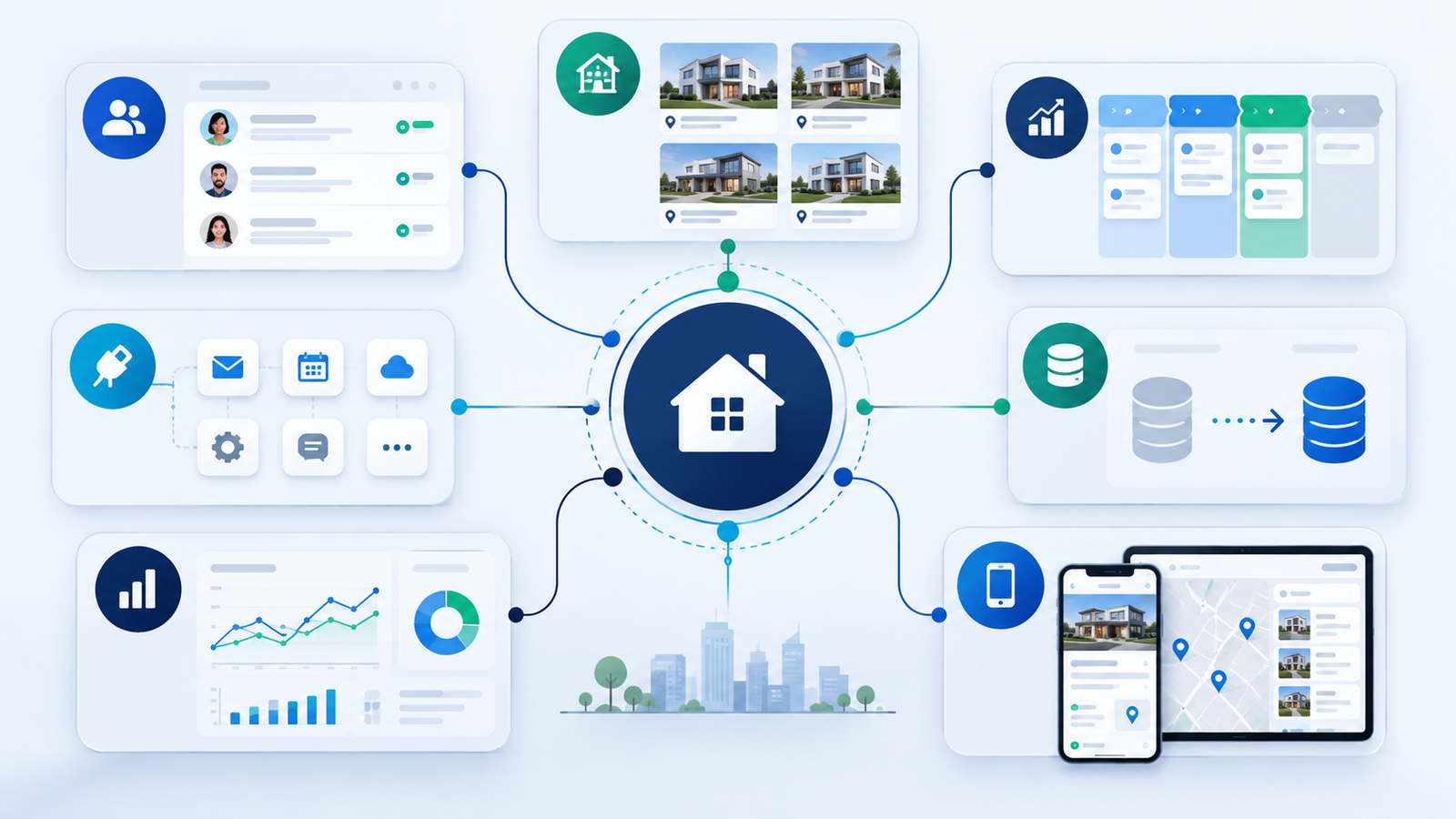
A useful estimate therefore begins with workflows and constraints—not a generic feature count. This guide explains the factors that change scope, what to define before requesting proposals and how to compare options fairly.
Start with the business workflow
Document how a qualified lead moves from source to outcome. Identify who owns each step, which information is required, where exceptions occur and which systems exchange data. A team that handles residential acquisitions may need seller intake, property records, appointments, offers and dispositions. A brokerage, property manager or commercial team will have a different model.
Try the fictional real estate CRM demo to see how contacts, properties and opportunities can remain connected without implying that one dashboard fits every company.
The seven biggest cost drivers
1. Data model and permissions
Simple contacts are inexpensive. Multiple companies, properties, ownership records, deals, role-based access, audit history and team-specific views require more design, testing and migration work.
2. Workflow depth
A stage field is simple. Conditional assignments, approvals, service-level timers, exception queues, notifications and rollback behavior add complexity because every branch needs predictable rules.
3. Integrations
Email, calling, messaging, accounting, maps, property data and advertising sources depend on external APIs and commercial terms. Verify endpoints, fields, webhooks, limits and licences before treating an integration as committed scope.
4. Data migration
Clean CSV imports are different from reconciling duplicates, attachments, notes, relationships and historical activities across spreadsheets or another platform. Test imports and reconciliation are essential.
5. Reporting
Basic counts are straightforward. Attribution, cohort reporting, pipeline ageing, permissions-aware dashboards and historical snapshots require clearer definitions and more reliable data.
6. AI and automation
Summaries or classification can be useful, but production AI also needs evaluation, confidence thresholds, privacy controls, logs and human review. Deterministic rules should handle explicit decisions.
7. Delivery and ownership
Discovery, UX, testing, deployment, monitoring, documentation, support and security work are part of a production system. A low build quote that excludes these responsibilities is not a comparable estimate.
Use delivery phases instead of one giant specification
- Discovery: map current workflows, data, integrations and measurable outcomes.
- Foundation: deliver identity, permissions, core records and one complete workflow.
- Operational release: add priority integrations, migration and reporting.
- Expansion: add advanced automation only after usage shows where it helps.
This reduces the risk of paying for assumptions and gives users a working system sooner.
Calculate total cost of ownership
Compare development with hosting, monitoring, vendor fees, maintenance, support and internal product ownership. Also measure the current cost of duplicate entry, missed handoffs and unreliable reporting. Custom development is justified when the operational value outweighs the ongoing responsibility.
Use the real estate CRM cost calculator for an indicative range based on users, modules, integrations, migration, mobile needs and AI. It is a planning tool, not a fixed quote.
Questions to ask every development partner
- Which assumptions are included or excluded?
- How will integrations be verified before commitment?
- Who owns source code, hosting and third-party accounts?
- How are security, backups, monitoring and incident response handled?
- What acceptance criteria determine completion?
- How will data be exported if the relationship ends?
For a requirements-led estimate, review custom real estate CRM development and request a workflow review.
Frequently asked questions
Can a CRM price be estimated from a feature list?
Only roughly. Workflow exceptions, data quality, permissions and integration constraints frequently change the effort more than headline features.
Is custom development always more expensive than buying software?
It normally requires more upfront investment. Long-term value depends on fit, subscriptions, workarounds, maintenance and the importance of owning the workflow.
Should AI be included in the first release?
Only when there is a bounded task, suitable data and a clear evaluation method. Many teams gain more first from reliable routing, tasks and reporting.