AI Agents for Real Estate: Use Cases, Architecture, Cost, and Human Oversight
Learn how AI agents can support real estate lead response, qualification, follow-up, documents, and reporting with clear architecture, costs, safeguards, and human oversight.
Zain
September 27, 2026

Looking to build this instead of buying it? See our AI Automation for Real Estate Workflows service →
What is an AI agent for real estate?
An AI agent for real estate is software that can interpret information, choose a next step within defined rules, and use approved tools to complete work. A practical example is reading a website enquiry, checking required details, creating a CRM task, and routing the lead to an acquisitions or sales manager.
The agent should have limited permissions, a clear owner, an audit trail, and a manual fallback. It should support professional judgment rather than make unsupervised decisions about contracts, pricing, payments, legal matters, or sensitive customer issues.
Practical AI-agent use cases
Lead response and qualification
An agent can acknowledge a new enquiry, collect missing information, classify intent, and suggest a priority using transparent criteria such as property type, location, timeline, and budget. A person should review uncertain or high-value cases.
Follow-up coordination
Agents can create reminders, draft follow-up messages, stop a sequence when a lead replies, and escalate overdue tasks. Consent, opt-outs, frequency limits, and approval rules should be visible to the team.
Property and document workflows
An agent can organize listing information, extract fields from documents, and flag missing data. Human review remains essential for legal, financial, identity, and compliance-related documents.
Pipeline and reporting assistance
Agents can summarize activity, identify stalled opportunities, and prepare daily pipeline briefs. Every recommendation should show its source instead of hiding decisions behind an unexplained score.
A practical AI-agent architecture
A reliable real-estate workflow usually includes:
- A CRM and property system as the source of truth
- An orchestration layer for deterministic workflow rules
- Retrieval from approved documents and knowledge sources
- Integrations for email, messaging, calendars, calling, and forms
- Permission and privacy controls
- Human approval queues for high-risk actions
- Logs, monitoring, evaluation, and rollback controls
Start with narrow tools and limited permissions. Expand only after the agent performs reliably on representative examples, including missing information, duplicate records, provider failures, and malicious or irrelevant requests.
For broader workflow design, see real-estate AI automation and custom CRM development.
How much does an AI agent cost?
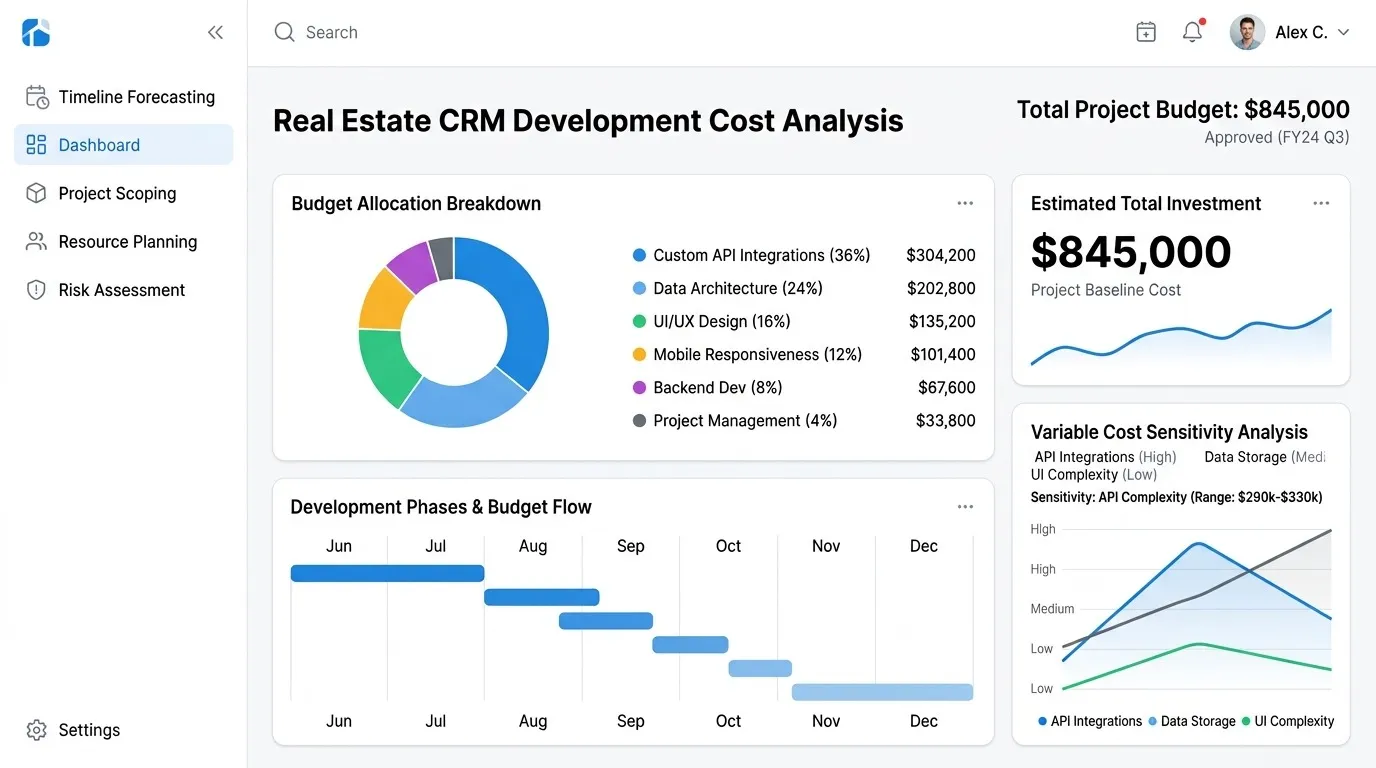
Cost depends on workflows, integrations, data sources, usage volume, security requirements, testing, and the amount of custom software required. Budget for discovery, CRM integration, orchestration, evaluation, monitoring, maintenance, training, and support.
A focused agent for one workflow is easier to measure than a general-purpose assistant. Define the expected result before choosing a model. If the project includes a CRM, use the real estate CRM cost calculator to explore scope drivers.
Human oversight and risk controls
Keep people involved when a workflow affects pricing, legal commitments, eligibility, payments, private data, customer complaints, or external messages. Useful controls include permission-based tool access, approval before high-impact actions, confidence thresholds, complete action logs, data-retention rules, abuse testing, and a manual fallback.
A sensible implementation path
- Choose one high-volume, low-risk workflow such as lead intake and task creation.
- Collect real examples, including difficult and exceptional cases.
- Connect only the data and tools needed for that workflow.
- Run with human review and measure response time, routing accuracy, errors, and acceptance.
- Add one integration or action at a time after the first workflow is stable.
AI agents can create leverage for real-estate teams, but the strongest systems are transparent, limited, and easy to override. Treat the agent as a controlled workflow participant—not an unmonitored replacement for professional judgment.
Frequently asked questions
What can an AI agent do for a real estate team?
It can respond to enquiries, collect qualifying details, create CRM tasks, summarize activity, and route leads. It should escalate pricing, legal, financial, and sensitive customer decisions to a person.
Can an AI agent update a real estate CRM?
It can propose or perform bounded updates when permissions, validation, confidence thresholds, logs, and human review match the risk of the change.
Should a real estate team build or buy an AI agent?
Use an existing tool when the workflow is standard and supported integrations are reliable. Consider custom development when the data model, workflow, integrations, or ownership requirements are a material business constraint.