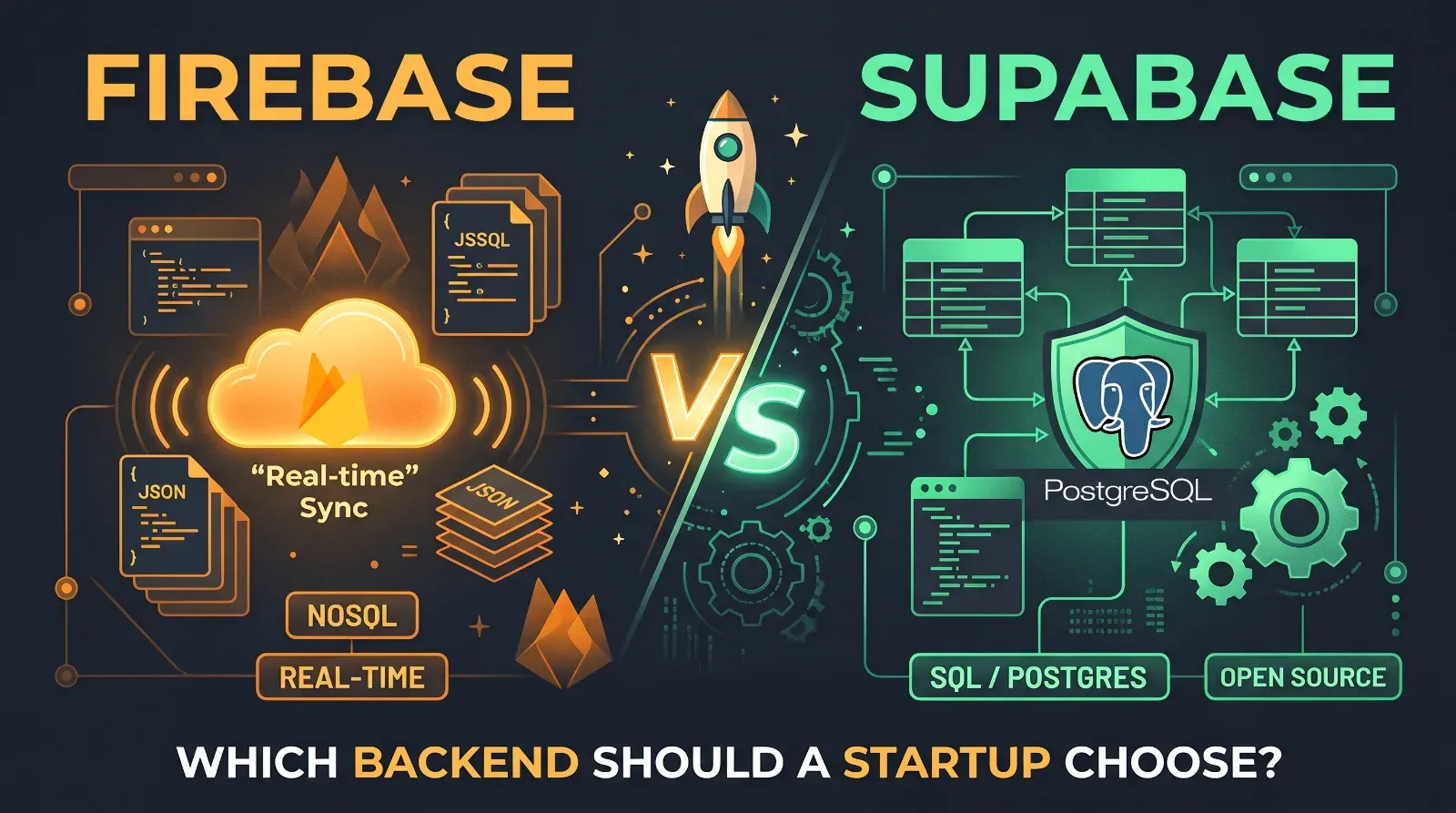
Firebase vs Supabase: Which Backend Should a Startup Choose?
Both get an MVP running quickly. They differ in data model, query power, lock-in and how costs behave as you grow. Here is how to choose.
DevGlim Team
November 15, 2026
Looking to build this instead of buying it? See our SaaS Development service →
Firebase and Supabase both promise a backend without servers to manage: authentication, a database, file storage and real-time updates. For an early product that is a real time saver. The decision that matters is not which has more features, but which data model and cost curve suits the product you are building.

The core difference: document database vs PostgreSQL
Firebase's main database, Firestore, stores documents in collections. It is fast to start and works well when you read and write whole documents, such as a user profile or a chat message. Queries are deliberately limited: joins do not exist, and complex filtering across fields often means restructuring data or adding indexes.
Supabase is built on PostgreSQL. You get tables, foreign keys, joins, transactions, views and SQL. Reporting, admin screens and anything relational (customers, orders, invoices, line items) are much easier to express.
Where each one fits
- Firebase suits mobile-first apps with simple data shapes, heavy real-time sync, offline support, and teams already inside the Google Cloud ecosystem.
- Supabase suits products with relational data, dashboards, multi-tenant SaaS, and teams that want the option to move the database elsewhere later.
Security rules
Firebase uses its own security-rules language. Supabase uses PostgreSQL row-level security policies written in SQL. Either can be done correctly and either can be done badly. The common failure in both is shipping with rules that are too permissive during development and never tightening them. Review access rules before launch, not after.
Cost behaviour
Firestore bills mainly by document reads, writes and deletes, so an inefficient screen that loads many documents can raise the bill without any growth in users. Supabase pricing is closer to conventional resource-based pricing (database size, compute, bandwidth), which tends to be easier to forecast. Check each provider's current pricing page when you decide; plans change.
Lock-in and exit
Supabase is open source and the database is standard PostgreSQL, so moving to another PostgreSQL host is a defined task. Firebase is proprietary: leaving means redesigning the data layer. For a prototype that is acceptable. For a product you expect to run for years, plan the exit cost up front.
A practical way to decide
- Sketch your five main screens and the data each one needs. If they join several entities, lean to PostgreSQL.
- List what must work offline. Firebase's offline sync is mature.
- Estimate reads per active user per day and check the price at ten times your launch volume.
- Decide who will maintain the backend in a year.
Many products outgrow a backend-as-a-service and move to a custom API. That is a normal path, not a failure, as long as the first version keeps business logic out of the client where possible. If you are choosing a stack for an MVP or planning a SaaS product, our MVP development and SaaS development teams can help you pick one you will not regret.