Custom Software Development for Startups: The Complete Guide
How startups should think about custom software development, MVPs, cost, and choosing a development partner as a non-technical founder.
DevGlim Team
August 3, 2026
Looking to build this instead of buying it? See our Custom Software Development Services service →
For most startups, the first serious software decision isn't "which framework" — it's "should we even build this custom, or can we get away with off-the-shelf and no-code tools for now?" This guide walks through that decision, what an MVP actually costs, and how to pick a development partner without a technical co-founder to vet them for you.
Why Startups Choose Custom Software
Most startups don't need custom software on day one — landing pages, CRMs, and no-code tools can validate an idea cheaply. Custom development usually becomes worth it once the product itself is the business: if what you're building can't be assembled from existing tools without compromising the core value proposition, it's time to build it properly.
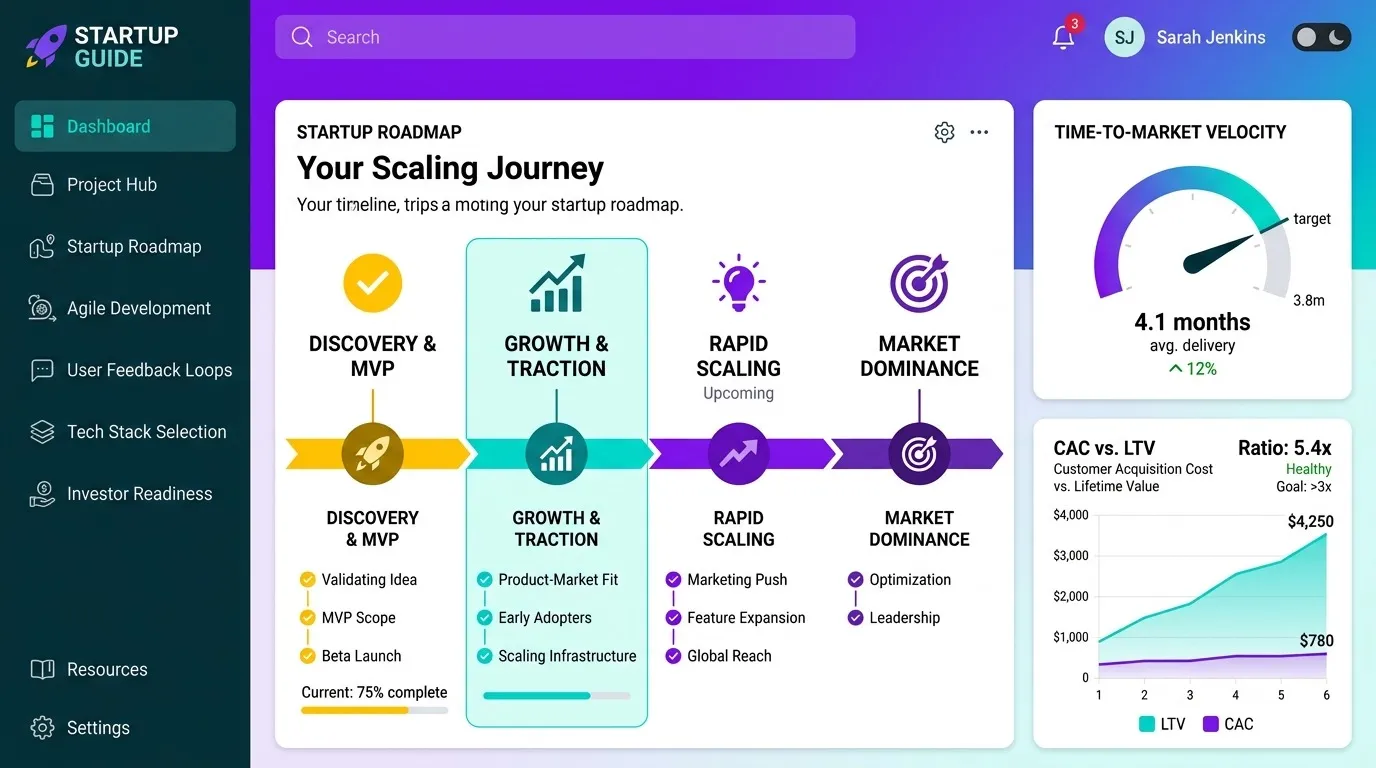
MVP vs. Full Product: Where to Start
An MVP (minimum viable product) is the smallest version of your product that lets you test your core assumption with real users — not a stripped-down version of your entire vision. The goal isn't to build less software, it's to learn as fast as possible whether the idea works before investing in the full feature set.
A well-scoped MVP typically takes 8–12 weeks to build and focuses on one core workflow, not every feature on your roadmap.
Bespoke Software vs. No-Code/Low-Code Tools
No-code and low-code tools are a reasonable starting point for internal tools, simple workflows, or validating demand before writing custom code. They break down when your product needs custom logic, has to scale past a few thousand users, or requires integrations the no-code platform doesn't support. A common pattern: validate with no-code, then rebuild the core product in custom code once you've proven demand.
How Much Does It Cost to Build Custom Software as a Startup?
A focused MVP typically runs from the low tens of thousands of dollars up to around $75,000–$100,000, depending on complexity, number of integrations, and whether it includes native mobile apps. The biggest cost driver isn't the code itself — it's scope creep from trying to launch with too many features. Startups that scope tightly around one core workflow consistently spend less and launch faster than those that try to ship a "complete" product on day one.
Choosing a Development Partner as a Non-Technical Founder
- Ask them to explain their process in plain language — if you can't follow it, that's a communication problem you'll have throughout the project.
- Ask what happens if requirements change mid-project (they will) — a good partner has a defined process for scope changes, not just "that'll cost extra."
- Get code ownership and IP transfer in writing before starting.
- Ask for references from other non-technical founders, not just enterprise clients — the working relationship is different.
Common Mistakes Startups Make
- Over-scoping the MVP — trying to build the full vision instead of the smallest testable version.
- Choosing the cheapest bid without checking process — a low price with no discovery phase usually means expensive rework later.
- Skipping a technical advisor — even a part-time technical advisor can catch scope and architecture issues a non-technical founder can't.
- Not planning for post-launch iteration — budgeting only for the initial build, with nothing left for the changes real users will demand.
Frequently Asked Questions
Should we hire freelancers, an agency, or build in-house first?
Freelancers can work for narrow, well-defined tasks, but coordinating a full product build across multiple freelancers adds risk. An agency with a dedicated team is usually more reliable for a first product build; in-house hiring makes more sense once you have enough validated demand to justify full-time engineering headcount.
What's a realistic timeline from idea to launched MVP?
With a tightly scoped MVP, 8–12 weeks from a finalized spec to launch is realistic. Add 2–4 weeks upfront for discovery and requirements if you're starting from a rough idea rather than a defined spec.
Fixed price or time-and-materials — which is better for a startup?
Fixed price works well for a tightly scoped MVP with clear requirements. Time-and-materials (or a dedicated team model) works better once you're past MVP and iterating based on user feedback, since requirements will keep changing.