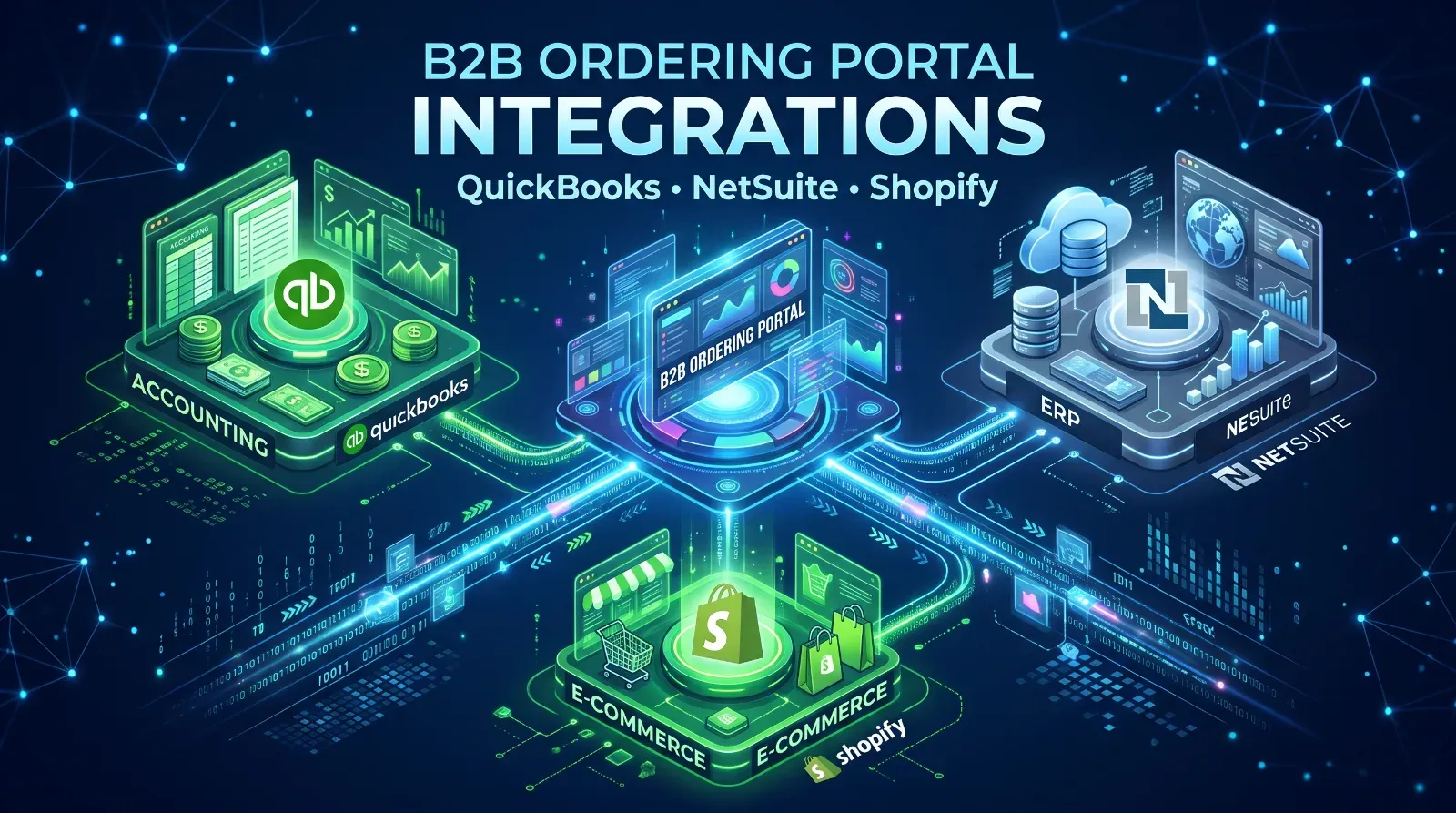
B2B Ordering Portal Integrations: QuickBooks, NetSuite and Shopify
A B2B portal is only as useful as its connection to your systems. Here is what to sync and what affects integration cost.
DevGlim Team
November 20, 2026
Looking to build this instead of buying it? See our B2B Ordering Portal Development for Wholesalers & Distributors service →
A B2B ordering portal lets your customers place orders themselves. But if it does not talk to your accounting, inventory and e-commerce systems, your team ends up retyping orders. This guide explains what to sync and what affects the cost.
Why integration matters for a B2B portal
- Fewer manual entry errors
- Customers see correct prices and stock
- Orders flow into accounting without rekeying
Faster invoicing and payment What usually gets synced
- Customers: accounts, contacts and price lists
- Products: catalogue, descriptions and units
- Inventory: stock levels and availability
- Orders: from portal to your back office
- Invoices and payments: status back to the customer
Decide which system is the source of truth for each type of data.
Integrating with QuickBooks, NetSuite or Shopify
Each platform has its own interface, limits and rules, and they change over time, so check current documentation before planning. In general:
- QuickBooks is common for smaller businesses and focuses on accounting data
- NetSuite suits larger operations with deeper inventory and order management
- Shopify often holds the product catalogue and online orders
Many portals connect to more than one of these.
Real-time or scheduled sync?
Real-time sync keeps stock and prices current but is harder to build and monitor. Scheduled sync, for example every few minutes or hourly, is simpler and often good enough. Match the choice to how fast your data changes. Common pitfalls
- Unclear source of truth, leading to conflicting data
- Duplicate customers and products
- Tax, currency and unit differences
- No alerts when a sync fails
- Integration limits on the platform side
What affects the cost
The number of systems, the data you sync, the sync frequency, error handling and testing. Integrations are often the least predictable part, so ask for them to be estimated separately.
Next step
List every place a customer order is retyped today. Those are your first integration targets.