
AI Lead Qualification for Real Estate: Workflow, Risks and ROI
A practical architecture for using AI in real estate lead qualification without turning uncertain predictions into unchecked decisions.
DevGlim Team
September 22, 2026 · Updated September 22, 2026
Looking to build this instead of buying it? See our A Custom Real Estate CRM Built Around Your Exact Workflow service →
AI lead qualification can summarize enquiries, extract details and recommend a next step. It should not become an unexplained gatekeeper that silently discards people or changes trusted CRM data.

The useful question is not “Can AI score leads?” It is: which decision needs support, what evidence is available, how costly is an error and where must a person remain responsible?
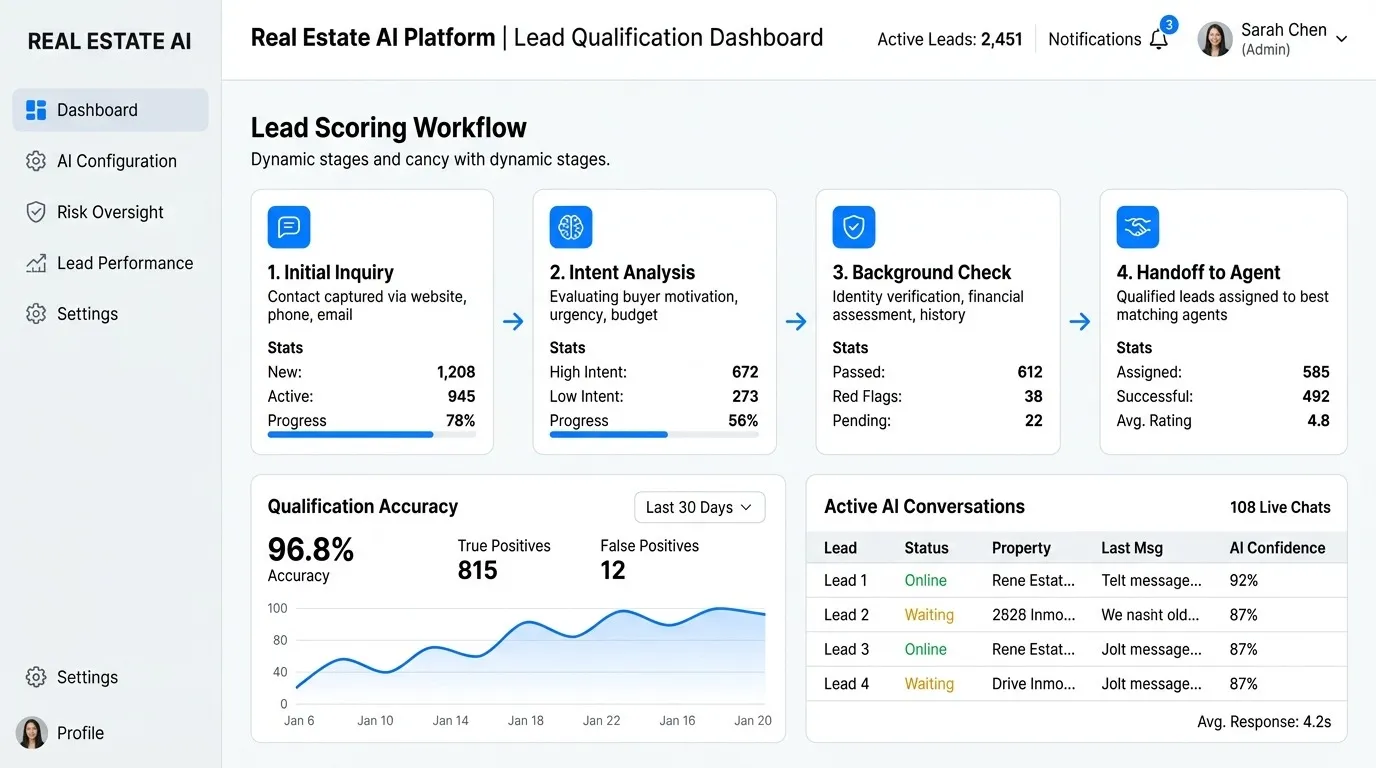
A safe qualification workflow
- Capture the original message, source and communication permissions.
- Use deterministic validation for required fields and obvious duplicates.
- Ask the model to extract or classify only defined information.
- Store evidence and confidence with the suggestion.
- Apply rules that limit allowed actions.
- Route ambiguous, high-value or conflicting cases to review.
- Record the final decision and outcome for evaluation.
Good AI tasks
- Summarizing a long enquiry for an agent
- Extracting a stated location, property type or timeline
- Classifying intent into a small, documented set
- Drafting a response from approved information
- Identifying missing information for follow-up
These tasks interpret language. Assignment, opt-out enforcement, permission checks and required approvals usually belong in deterministic rules.
Common failure modes
Confident guesses
A model may infer motivation, budget or urgency that the lead never stated. Separate explicit facts from predictions and never overwrite the source text.
Biased prioritization
Historical outcomes may reflect uneven treatment or incomplete data. Review inputs, test groups and avoid protected or inappropriate proxies.
Automation without consent controls
A good score does not create permission to contact someone. Channel eligibility must be enforced independently.
No feedback loop
Without final outcomes and reviewer corrections, teams cannot determine whether the model helps.
Measure ROI with a baseline
Measure time to review, time to first meaningful response, percentage of suggestions accepted, correction rate, false escalation, qualified-to-appointment conversion and cost per reviewed lead. Compare against a pre-AI baseline and track errors alongside speed.
Do not claim value from the number of summaries generated. Value comes from a better operational outcome with acceptable risk and cost.
Architecture and governance
- Send only the minimum data needed for the task.
- Define model and vendor data-handling terms.
- Use versioned prompts and structured outputs.
- Validate output against an allowed schema.
- Log inputs, outputs, rules and human overrides appropriately.
- Provide a kill switch and manual fallback.
- Re-evaluate after model, prompt or workflow changes.
Build or integrate?
Start with an existing CRM capability when it fits and gives adequate controls. A custom layer may be warranted when qualification depends on a unique data model, several systems or review logic that the platform cannot express reliably.
Read about real estate AI automation and CRM automation workflows. Then explore the review queue in the fictional CRM demo.
Frequently asked questions
Can AI automatically reject real estate leads?
That is a high-risk design choice. Most teams should use AI to support prioritization and review, with explicit rules and accountable human decisions.
What data is needed?
Begin with enquiry text, permitted source data and clearly defined outcomes. More data is not automatically better; relevance, quality and lawful use matter.
How should accuracy be tested?
Use a representative labelled test set, measure errors by class, review difficult cases and repeat evaluation whenever the system changes.