RAG Applications for Business: What They Are and When They Make Sense
Retrieval-augmented generation lets an AI model answer from your own documents instead of guessing. It is useful, but only when the source material and access rules are right.
DevGlim Team
November 12, 2026
Looking to build this instead of buying it? See our AI Business Automation service →
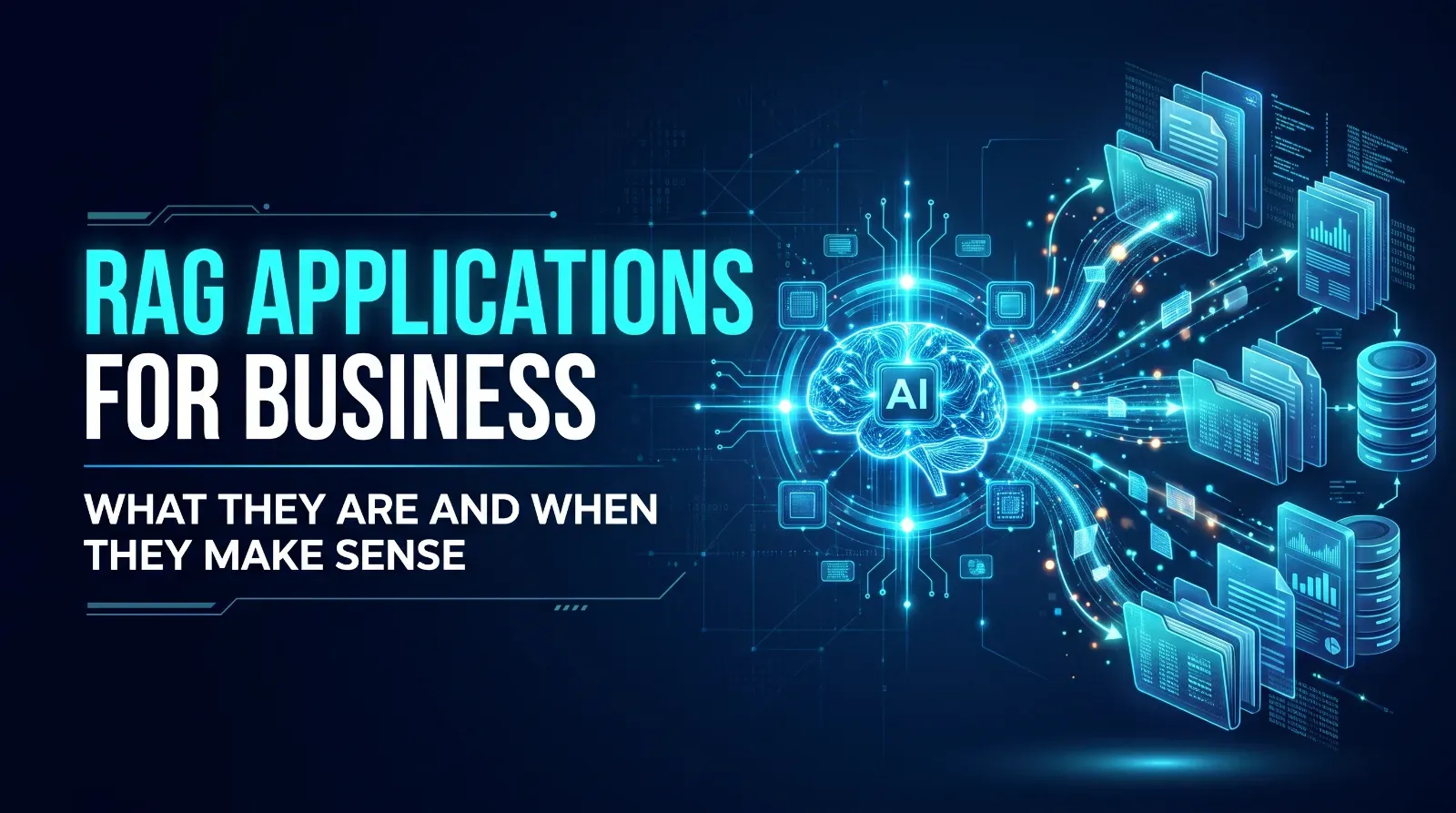
A RAG (retrieval-augmented generation) application answers questions using your own documents. Instead of relying only on what a language model learned in training, it first searches your content, hands the relevant passages to the model, and asks it to answer from those passages.

How it works
- Ingest. Documents such as policies, manuals, tickets or product pages are split into chunks.
- Index. Each chunk is stored with a numeric representation (an embedding) in a search index, often alongside keyword search.
- Retrieve. For a question, the most relevant chunks are found.
- Generate. The model writes an answer from those chunks, ideally with references to the sources.
Good business uses
- Internal assistants for HR, IT and operations policies.
- Support agents that draft answers from a knowledge base.
- Sales teams searching product documentation and past proposals.
Where RAG fails
- Poor source content. Outdated, contradictory or missing documents produce confident wrong answers. Fix the content first.
- Bad chunking or retrieval. If the right passage is not retrieved, the model cannot use it. Evaluate retrieval separately from generation.
- Permissions. A user must only receive answers from documents they are allowed to see. Enforce access at retrieval time.
- No evaluation. Build a test set of real questions with known answers and re-run it after every change.
Starting small
Pick one narrow use case with clean documents, require source citations in every answer, let staff flag wrong answers, and measure deflected questions or time saved before expanding. Keep a human in the loop for anything that affects customers, money or compliance.
We build custom AI agents and workflow automation connected to the systems you already use. See AI business automation and AI agent development, or try the AI workflow assessment to find a good first use case.