
Nginx vs Apache: Which Web Server Should You Use?
Apache is flexible and configurable per directory. Nginx is lean and strong at serving many connections. Many production setups use Nginx in front, and that is fine.
DevGlim Team
November 13, 2026
Looking to build this instead of buying it? See our Web App Development service →
Nginx and Apache HTTP Server are the two most widely deployed open-source web servers. Both are reliable in production. The practical differences are in how they handle connections, how you configure them, and what your hosting environment supports.

Architecture
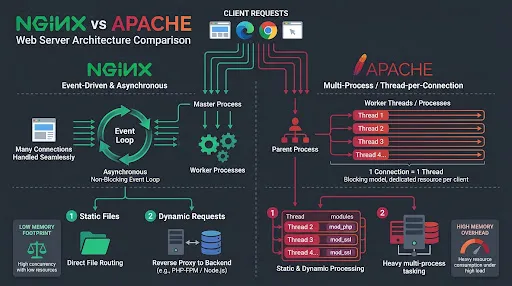
Apache can handle requests with processes or threads (depending on the module you use) and has a long-standing module system. Nginx uses an event-driven design that serves many simultaneous connections with a small, predictable amount of memory, which is why it is popular as a front-facing server and reverse proxy.
Configuration
- Apache supports per-directory
.htaccessfiles. That is convenient on shared hosting, where users cannot edit the main configuration, but it adds a lookup on each request. - Nginx has no
.htaccess; all configuration lives in the server config and is reloaded centrally. This is faster and easier to audit, but rules written for Apache must be translated.
Static files and dynamic apps
Nginx is very efficient at serving static assets and proxying to an application server (Node, Python, PHP-FPM). Apache can run PHP in-process through a module or hand off to PHP-FPM. For modern PHP, Python and Node applications, a reverse-proxy setup is common with either server.
Using both
A frequent pattern is Nginx at the edge for TLS, caching, compression and static files, forwarding application requests to Apache or an application server behind it. This is useful when you have legacy .htaccess-based software that you cannot rewrite yet.
How to choose
- On shared hosting you usually do not choose; follow the host's stack.
- For a new VPS or container deployment, Nginx is a common default.
- If your application relies on Apache modules or
.htaccessrewrite rules, Apache avoids a migration. - Whichever you pick, enable HTTPS, compression and sensible caching headers, and keep the server patched.
Server choice is a small part of web performance; application code, database queries and asset size usually matter more. If your site or web application is slow or hard to deploy, our web application team can review the whole stack.